101 Games for the English as Second
Language (ESL) classroom Compiled and Edited by Jeffrey Scott Longstaff ( www.laban-analyses.org/jeffrey/
) 1st Edition – February 6, 2012 |
|
Introduction |
|
Definition of “Game” Participants in “English as
a second language” (ESL) often say that they like to play “games” as a fun
way to learn. However some teachers
also say that they don’t know what games to play. There are many ESL web sites where users
have submitted a large number of games, however frequently a great portion of
these “games” are not “true games” but might be more accurately described as
“fun activities”. . The list of games here are
all “true games” in the sense of the 1st definition of “game”
being “a form of competitive activity or sport played according to rules”
(Oxford Dictionary; World English 2012).
The active component is “competition” which brings excitement and thus
motivation to participate. . Hence, all the games here
have rules and lead to winners or losers of the game. . Having winners and losers
might be criticized (no one wants to be a “loser”), this is an important
issue but for the sake of brevity it is not considered here. Hopefully these games can be played for their
benefit of increasing student motivation.
Winners and losers do not need to be highlighted. Prizes can be given to everyone if
desired. It is possible to play the
games but not keep track of the “points”.
Any game can also include random events where players gain or lose
points by chance (see the game: “level the playing field”). . Moreover, competition is
part of life. Learning
“sportsmanship”, “fair play” and how to be a good winner and a good loser are
important lessons that can be taught through playing games. . |
|
Organisation of the games The best way to organise
the list of games is not clear. Many
ESL web sites list games according to student level, games for beginning,
intermediate, or advanced level students.
However this organisation is not used here, because most games can be
adapted (for example by changing the vocabulary or grammar used) to be
useable in many different skill levels. . The organisation of the
games here is somewhat ad hoc,
unplanned, it is a work in progress. The games have been put into a few
categories, but these are not considered to be a final or a “best”
organisation. . Generally, games have been
grouped according to a “task-based approach”, so that game using a particular
task (eg. “Bingo”) are all put together in one category. . Further, “keywords” have
been listed for each game. Again,
these are ad hoc, a work in
progress. They are not complete or
considered to be the best solution. . Finally, a note is made for
each game on how much “preparation” is required before playing the game. Many games require no preparation at all,
so can be quickly used without any preplanning. . |
|
Many games are very similar Many of the games are very
similar. There are often several versions
of the same game from different countries and cultures or having developed
from individual teachers’ styles. . Many variations have been
attempted to be included here, while also trying to have as little
duplication as possible (though some duplication was unavoidable). Some games have several “variations”
listed, while other variations have been listed as separate games even though
the game-play may be quite similar. . There are more variations
possible than are listed here! It is
up to the teacher to use the ideas of the game, feel free to modify them, and
make new variations to fit one’s own style and the needs of the students. . Overall, the main purpose
of games is to have fun! So feel free
to experiment and be creative! |
|
Compiler and Editor: 1st Edition I am not the author of
these games and I’ve only played a few of them in class. My role has only been to
collect them from many places and edit them into one concise format. -
In this 1st edition, there
are also likely to be many mistakes, please send any notes to me! - Jeffrey |
|
LIST OF
GAMES |
|
|
|
Body
movement with a few words |
|
1. |
Simon Says! “Simon” tells players what to do, but players should
only do it if he first says “Simon says” |
|
2. |
Mother may I?
Father may I? Players in the back try to touch “Mother” or “Father”
who will tell them what they may do. |
|
3. |
Red light, Green light! -
Statues! Players in the back, try to touch a player in the
front, but if seen moving they must start over. |
|
4. |
What time is it Mr. Wolf? - What’s the time Mr. Wolf? Players ask Mr. Wolf about the time, ... then run away
when it’s time for dinner! |
|
5. |
Catch! Play
Ball! Players ask a question, then throw a ball to another
player who must answer. |
|
6. |
Twister! Body parts & colors are called out, players reach for
the colors in the “twister” play area. |
|
7. |
Red Rover! Team #1 calls for a player from Team #2 who tries to
break through their line or is caught. |
|
|
Recognition
of key-words or finding words and objects |
|
8. |
Show me! Each player gets a card, when someone says the name of
the card, they hold it up and show it. |
|
9. |
Hold it up! Teams get all the cards, when someone says the name of
a card, teams find it and hold it up. |
|
10. |
That’s my word! A text is read aloud, players have keywords, when
hearing one’s own word, stand up & say it. |
|
11. |
Grab that word! Play a song, keywords are on cards stuck on the board,
when hearing a word, run and grab it. |
|
12. |
Scavenger hunt! Teams get lists of “things” to find (words, objects,
information), team that finds the most wins! |
|
|
Identifying
differences |
|
13. |
What changed? A few players leave the room, others change things,
players return & guess what has changed. |
|
14. |
Find the differences! Players try to find differences between two similar
pictures without looking at the other one. |
|
|
Giving
directions |
|
15. |
Pin the tail on the donkey! One player is blindfolded, others give directions where
to put various body parts on a picture |
|
16. |
Find the treasure! One player is blindfolded, others give directions on
how to go somewhere and find a treasure. |
|
|
Repetition: Drilling, Clapping, Chanting |
|
17. |
Clapping syllables! Players clap the rhythm of syllables in words or
sentences, competing for accuracy and style. |
|
18. |
Bigger and bigger! Players say words over and over while getting bigger
& bigger and speaking louder & louder. |
|
19. |
“Beep” game! Players say numbers or letters in the correct order,
except sometimes say “Beep” instead. |
|
20. |
Speed naming! Words or pictures are on the board, players say the
words in random order as fast as possible. |
|
21. |
Speed naming! - Punctuation! Players randomly point at punctuation signs while
others say their names as fast as possible. |
|
|
Relaying
information from one to another |
|
22. |
What’s on your back? Players each write a letter or word on another’s back,
the last player writes it on the board. |
|
23. |
Telephone!
Whisper circle! One player reads a sentence, tells it to the next
player, etc., the last player says it to the teacher. |
|
24. |
Relay the story!
Dictation! One player reads a short story, tells it bit by bit to
the next player, etc., the last player writes it. |
|
|
Guess! - a word - an object - a person - a
sentence - a story... |
|
25. |
Guess the word! A picture or drawing is held up, players try to
remember words for things in the drawing. |
|
26. |
I spy with my little eye! I hear with my little ear! A player picks a thing within sight (or hearing) and
gives a clue, other players guess what it is. |
|
27. |
Fly swatter!
Whack the word! Words are written or placed in the room, a “clue” is
given, players run to “whack” the word. |
|
28. |
Fly swatter! Whack
the word! - Categories & Contexts! A “clue” is given for an object, players run to “whack”
the context where it would be found. |
|
29. |
Duel! Bang
bang! Two teams each send 1 player forward, a “clue” is given
for a word, 1st player to guess it wins. |
|
|
|
|
30. |
Twenty questions! One player picks a word, other players can ask up to 20
“yes / no” questions to guess the word. |
|
31. |
Three lives! Players ask “yes / no” questions to guess a word but
get only 3 “no” answers = lost all 3 lives! |
|
32. |
Hang man! Players ask “yes / no” questions to guess a word, “no”
answers get the player closer to hanging. |
|
33. |
What are you talking (writing) about? Players write descriptions of something in the room,
then other players try to guess what it is. |
|
|
|
|
34. |
Describe your friend! Players write descriptions of each other, then other
players try to guess who is being described. |
|
35. |
Guess your classmates! Players write their names & something special about
themselves, other players guess who it is. |
|
36. |
The name game! Player #1 faces away, another player says “My name
is...” Player #1 says “true” or “false”. |
|
37. |
Who is it?
“If they were a . . . , then what . . . would they be?” One player is “it”, other players try to guess who “it”
is by asking “If this person was a ...” |
|
38. |
Who are you talking about! Players describe someone, others make drawings from the
description and guess who it is. |
|
39. |
Police sketch artists! Witnesses describe someone, sketch artists draw the
person, detectives try to find the person. |
|
|
|
|
40. |
Who are you?
What are you? (changing
partners) Players write what they are on a card, partners
guess it - then switch cards & find new partners. |
|
41. |
Guess who!
Guess what! (groups) One player picks something to be (an object, a famous
person,...) other players try to guess. |
|
42. |
Who are they?
What are they? ( ½ & ½ ) Half of the players each pick something to be, ½ of
the class guesses who the other ½ is. |
|
43. |
Who am I?
What am I? Where am I? Players don’t know who, what, or where they are, but
it’s written on their head, they can guess. |
|
44. |
Hot seat! Each team sends one player to the front, then gives
clues so their player can guess the word. |
|
45. |
Pictionary!
Charades! Guessers
try to guess a word or phrase & performers
give clues drawing or acting it out. |
|
|
a.
Pictionary!
Charades! -- Team 1 versus Team 2! Team 1 gives Team 2 a word or phrase to
perform & guess, then Teams 1 and 2 reverse roles. |
|
|
b.
Pictionary!
Charades! -- First team to guess! Each team performs and tries to guess
the same word or phrase. The first team to guess, wins! |
|
|
c.
Pictionary!
Charades! -- How many can you guess! Each
team tries to guess as many words or phrases as possible within a time limit. |
|
|
d.
Pictionary!
Charades! -- Who can guess first? Everyone plays together, with one player
performing and everyone else trying to guess. |
|
|
|
|
46. |
Sentence Charades!
(or Pictionary) One team performs or draws pictures, the guessers try
to guess an entire secret sentence. |
|
47. |
Adjective Charades!
(or Pictionary) Players perform or draw an animal and an adjective,
other players guess both words. |
|
48. |
Adverb Charades!
(or Pictionary) Players use an adverb, other players tell them to do an
activity and try to guess their adverb. |
|
49. |
Do it with feeling!
(Charades) Players perform actions with feelings, teams try to
guess the verbs and adjectives or adverbs. |
|
50. |
Utter nonsense!
A (totally) foreign language! Players perform a conversation or scene using
“gibberish”, other players guess what it is about. |
|
51. |
Laryngitis!
Get the gist! (Charades &
Pictionary for stories) Players try to communicate a story without speaking,
other players try to understand the gist. |
|
52. |
Password! One player in the team says a one-word clue, the other
player in that team tries to guess a word. |
|
53. |
Performance password! Players in a team give a performance with dialogue,
other players guess a secret word. |
|
|
Recalling
groups or series |
|
54. |
Accumulation (I went to the market and bought...) Players repeat a basic sentence followed by an
ever-lengthening list of items in the category. |
|
55. |
Matching / Concentration Players look for matching cards (2 pictures, 2 words,
or 1 word with 1 picture) |
|
56. |
Kim’s Game (from the book “Kim” by
Rudyard Kipling) Players briefly see a collection of
objects, words, pictures, then recall them later. |
|
|
|
|
|
Generating
categories |
|
57. |
Name 6! (Pass
the toy) A toy is passed around a circle of 7 players while one
player names 6 members of a category. |
|
58. |
How many words? Players in teams run to the board and write as many
words (in a category) as they can think of. |
|
59. |
Memory box!
/ Think fast! Teams pick different categories and write as many words
as they can think of in their category. |
|
60. |
Things we do with our ... Teacher writes a phrase (“Things we do with our...”) -
teams write verbs in that category. |
|
61. |
Word chain
/ Words leading / Shiritori Players run to the board & write words that begin
with the letter that the last word ended with. |
|
62. |
Words of a letter flock together (Birds of a feather
flock together) Teacher says a letter, each student must say a word
that begins with that letter. |
|
63. |
Alphabet words! The first student says a word that starts with “A”,
next student’s word starts with “B”, etc. |
|
64. |
Stop the alphabet! Say the alphabet till someone yells “stop!” - write
categories of words starting with that letter. |
|
65. |
Alphabet cards! Players turn over cards (with letters), then say words
or sentences beginning with those letters. |
|
66. |
Smile!
Similar similes! Teams race “as fast as ......” to see who can make the
most similes within a time limit. |
|
|
Spelling |
|
67. |
Spelling duel! Two players come forward, each player says a word, then
try to spell the other player’s word. |
|
68. |
Survivor spelling: letter - by - letter! Player #1 says the 1st letter of a word,
player #2 the 2nd etc. -make a mistake and you’re “out”. |
|
69. |
Survivor spelling: word - by - word! (Spelling bee) Each player tries to spell a word. When a player makes a mistake, they are
“out”. |
|
70. |
Team spelling! Each team sends players forward to spell words and earn
points for their team. |
|
|
Arranging
& Rearranging: letters into words
/ words into sentences |
|
71. |
Finding needles in a haystack! (from Sally, Joanna, Michelle, & Fiona) Players get a card with a word and they must ask other
players for the letters to spell that word. |
|
72. |
Changing letters! - Making words! A word is written on the board, each player changes one
letter to make a new word. |
|
73. |
Arrange and rearrange the letters! Players get cards with letters, a word is said and
players arrange the letters to make the word. |
|
74. |
Conundrum!
Arrange the letters! Players see letters in random order, then rearrange the
letters to make the word or short phrase. |
|
75. |
Advanced conundrum! Players randomly pick letters & teams use the
letters to try to make the longest word possible. |
|
76. |
Reverse conundrum! Players
see a long word, then use the letters to make as many other words as
possible. |
|
77. |
Scrabble! Players
randomly pick letters, then arrange those letters to spell words as long as
possible. |
|
|
|
|
78. |
Arrange and rearrange the words! Players take cards with words written on them and arrange
these into correct sentences. |
|
79. |
Arrange the song! Players arrange words on cards into the correct order
of a song. |
|
80. |
Arrange and rearrange the parts of speech! Players arrange parts of speech (grammar words written
on cards) into correct orders. |
|
81. |
Arrange the words “KABADI”! Players put words in order as fast as possible without
breathing -continuously saying “Kabadi”. |
|
82. |
Position the prepositions! Teams compete to arrange prepositions into the correct
locations within sentences. |
|
|
Writing
sentences and stories |
|
83. |
Run and write!
(Sentence race!) A word is called out, players run to the board and
write a sentence as fast as possible. |
|
84. |
Sentences: word - by - word! A category is called out, players take turns saying one
word, gradually making a sentence. |
|
|
|
|
85. |
Crazy stories: word - by - word! (not a true game, but tried to make it so) Words & phrases are blindly put in columns, the story is read & players guess who
wrote what. Players blindly
put words & phrases in columns, read the story & others guess who
wrote what. |
|
86. |
Crazy stories:
what was your word? Players write 1 word, use it in a sentence in a story,
and players guess: What was your word? |
|
87. |
Crazy stories:
sentence - by - sentence! (not
a true game, but tried to make it so) Players write sentences in rows, then hide what they
wrote, finally the story is read. |
|
|
Exaggeration,
Stretching the Truth |
|
88. |
Liar! Liar!
-- Alphabet Liar! Number Liar!
Card game where players try to discard as many cards as
possible, even if they must lie. |
|
89. |
Have you ever? Players tell stories about things they’ve done, other
players try to figure out if they are true. |
|
90. |
The biggest bragger! Players compete to come up with the biggest boasts and
brags (regardless how unlikely). |
|
|
Grammar
& Verb tenses |
|
91. |
Mr. Ed! The
sounds of Ed! Teams
race to collect regular verbs into 3 groups, depending on sounds of “-ed”
(-t, -d, or +ed). |
|
92. |
Run and write!
(Active voice, Passive voice) Players from each team run to the board and change a
sentence’s grammar as fast as possible. |
|
93. |
How much for this sentence? Sentence auction! Players bargain to try to buy sentences with good
grammar, but not to buy those that are poor. |
|
94. |
Feeling tense?
(Tenses, phrase by phrase) One player says a phrase indicating a time, the next
player finishes the sentence in that tense. |
|
|
Quizzes
- Questions & Answers |
|
95. |
Team questions! Groups
make questions about a text and ask them to other groups who must answer
fast. |
|
96. |
Quiz show! Questions
are asked about any subject and teams compete to answer them quickly. |
|
97. |
What’s the question?
(Jeopardy!) Answers to questions are given, and teams compete to
see who can provide the questions. |
|
98. |
“True” Jeopardy! Answers
are organised into categories and difficulty (points) which teams can select
from. |
|
99. |
Comedy quiz! Players
try to answer questions with comedic answers. |
|
|
“Bingo”
& “Tic Tac Toe” (rows in a grid) |
|
100.
|
Bingo! (basic game) A
number is called out, players who have it on their card get that square: “3
in a row” wins. |
|
|
a.
Vocabulary Bingo! A “3 in a row”
wins. |
|
|
b.
Question & Answer Bingo! A
question is called out, players who have the answer on their cards get that
square. |
|
|
c.
Irregular verb Bingo! An irregular verb is called out: get that square if the
past tense of that verb is on your card |
|
|
d.
Shout it out Bingo! A word is called out, but only the 1st
player to shout the word gets that square on their card. |
|
|
e.
Grammar Bingo! The word or answer must be shouted out in a sentence in
a correct form of grammar. |
|
|
f.
Getting to know you Bingo! Players
ask 8 others about themselves & write this on bingo cards, win if the
names are called. |
|
|
|
|
101.
|
Tic Tac Toe! (Naughts and Crosses)
(basic game) Players
pick a square and get it if they can say the word in that square “3 in a row”
wins. |
|
|
a.
Question & Answer Tic Tac Toe! Players pick a square, if they answer a question
correctly, then they get that square. |
|
|
b.
Grammar Tic Tac Toe! Players get a square if they say a correct sentence
with the requested grammar and vocabulary. |
|
|
“Extras”
- Add to any game for more fun! |
|
102.
|
Secret Code! Written instructions are given in secret code, players
work out the code as fast as they can! |
|
103.
|
Watch the Time! A
time limit for an activity depends on an irregular event (spinning a top,
saying the alphabet)! |
|
104.
|
Level the playing field! Bonus
Round! When
a player or team gets points, the number gained (or lost!) is decided by
chance! |
|
105.
|
Punish the losers! Instead
of rewarding winners, making losing exciting with fun activities for
“punishment”! |
|
106.
|
Police! If
a player breaks a rule of the game they are punished by losing time or losing
points! |
|
|
|
|
The Games! |
|
Body movement with a few words |
|
Simon Says! |
(Preparation: None!)
. |
|
/ recognize keywords / body movement / commands
- imperative mood
/ |
|
|
One player is
designated as “Simon” who
stands in front and gives players commands to do things Two main rules: -
A
command starting with “Simon says”
means players must do it -
A
command that does not start
with “Simon says” means players must not do it. §
If
any player breaks either rule, they are “out”
and stop playing After everyone
else is “out” the last person
remaining becomes the next “Simon” |
|
|
Simon can
command players to do almost anything that is physically possible, for example: §
stand up, sit
down, touch your left ear, say "yes", sing a song §
Simon
can also direct “commands” to just some of the players (calling them by name) §
To
make it more exciting (and difficult) Simon can say many commands very
quickly, for example: o Simon says stand up. Simon says sit down. Simon says arms
up. Arms down. (anyone ending
with “arms down” is “out”,
because that command did not begin with “Simon says” |
|
|
Mother may I? Father may I? |
(Preparation: None!)
. |
|
/
body movement / commands / questions / speaking /
outdoors / spatial directions / |
|
|
The game is
played in a large open room (no desks or chairs) or outdoors -
One
player is designated as “Mother”
or “Father” and stands in
the front -
The
rest of the players start standing in the back of the room (or as far away as
possible) The goal is to
get permission to come forward -
the
first player to touch mother or father wins!
(and becomes the new mother or father) Commands about
movements can include: -
Types of movements (steps, runs, jumps,
crawls, leaps,...) -
Number of steps, runs, jumps, etc. -
Time for stepping, running, jumping etc. -
Size of steps, runs, jumps (big, small,
tiny, “mouse-sized”, “elephant steps”, etc.) -
Direction of steps, runs, jumps. etc. |
|
|
Variation 1:
Mother or Father give commands to particular players (“Bob, take 2
mouse steps forward”) -
the
player must first ask: “Mother may I?”
(or “Father may I?”) -
If
mother or father says “Yes”, then the player gets to take the steps §
If
the player doesn’t ask, or §
If
the player takes the steps before
mother / father says yes, o then that player must go to the back
and start again |
|
|
Variation 2:
Same as Variation 1,
except the players can also ask
mother or father: -
“Mother,
may I take take 2 seconds of tiny steps forward” -
Mother
/ Father can reply “Yes” or “No” §
If
“Yes” then the player can do it. §
If “No” then the player cannot do it, but
Mother / Father can make a different command: o “No, but you can take 2 seconds of
hopping forward” |
|
|
Variation:
Instead of “Mother may I?”
players ask “Mother, do I
have to?”, or “Mother, must
I?” etc. |
|
|
Red light, Green light! -
Statues! |
(Preparation: None!)
. |
|
/ recognize keywords / body movement / commands / speaking /
outdoors / |
|
|
The game is
played in a large open room (no desks or chairs) or outdoors -
One
person (the “police officer”)
stands in front, -
all
other players begin at the back (farthest away from the front) -
The
person in the front says “Green Light” and turns away (his / her back towards
the others) -
Other
players try to come forward towards the front -
At
any time the “police officer”
can turn around §
All
the other players must freeze, stand still, like statues §
The
“police officer” can walk
around looking at the players closely and can try to startle them! (but cannot touch them) §
If
the “police officer” sees
anyone moving, then that person goes to the back to start over -
Anytime
the “police officer” has
their back to the other players, they can move -
The
first person to touch the “police
officer” wins, and becomes the
next officer |
|
|
Variation:
Instead of a “police officer”
, the person in front is a museum “curator” |
|
|
What’s the time Mr. Wolf? / What time is it Mr. Wolf? |
(Preparation: None!)
. |
|
/
recognize keywords / telling time /
body movement / questions
/ |
|
|
Need large open
area to play Simple game
for learning how to tell the time on the clock -
one
person is selected as “Mr. Wolf” (could be the teacher first) -
All
other players ask Mr. Wolf a question:
“What’s the time Mr. Wolf?” -
Mr.
Wolf answers, saying any time: “It’s 2 o’clock” Repeat
questions and answers -
Mr.
Wolf can answer with any time, including variations (5:30 pm, half past 4, 12
midnight, etc.) -
continue
till Mr. Wolf answers “It’s dinner time!” §
Then
Mr. Wolf runs to catch one of the players §
the
1st player who is caught becomes the next Mr. Wolf |
|
|
Variation: It
is possible to play this game with: -
different
questions and different vocabulary answers -
different
animals §
“What
are you having for lunch today Mr. Wolf?”
(Mr. Shark, Mrs. Tiger....) o I’m having rice for lunch. o I’m having dumplings for lunch. o I’m having Children for lunch! (run and catch the next Mr. Wolf) |
|
|
Catch! Play Ball! |
(Preparation: need a ball or soft object to throw &
catch) . |
|
/
conversation / questions
/ body movement /
passing a ball or toy / speaking / |
|
|
Bring a ball to
class: Whoever has the ball, must
speak -
Teacher
starts, asks any question,
(What are you doing tomorrow?) then throws the ball to someone -
The
student catches the ball and must
answer the question -
If
the student drops the ball
or hesitates more than 5 seconds
- then he/she takes the role of “teacher” Keep throwing
the ball back and forth from: “Teacher” (or student in that role) to / from
Student |
|
|
Questions to use in the game: -
The
questions used in the game can be anything - but should be able to be answered quickly -
1-word / 2-word answers are best
for example: -
a
vocabulary word from a category (Name a color! What day is today? What’s your favorite food?) -
or more
difficult (Who wrote the book “Oliver”?
Who was the 2nd president of -
or
could be grammar questions (What is the past participle of “to see”?) -
or general
questions (What are you doing tomorrow?
What’s for dinner tonight?) |
|
|
Catch! Play Ball! |
(Preparation: need a ball or soft object to throw &
catch) . |
|
/
conversation / questions
/ body movement /
passing a ball or toy / speaking / |
|
|
Variations on
“Catch! Play Ball!” |
|
|
1) The ball can be thrown back and forth
between teacher and a student, with the teacher always asking the question
and a student giving the answer. 2) The ball could also be thrown randomly
from student to student: ·
Players alternate: question, answer,
question, answer: One player asks a question, then throws the
ball to the next player who answers, who throws the ball to the next who asks
another question, etc. ·
Each player answers and then asks a new
question: A player
answers the last question, then asks a new question before throwing it to any
other player who then answers the question, and asks another. |
|
|
Variation:
Answers must be in a certain grammar structure -
If
a student doesn’t use that grammar, then they take the role of “teacher” |
|
|
Variation:
Have several balls,
with a different colors -
Each
ball indicates a different sentence to say -
Throw
or pass the balls randomly amongst students -
Whoever
catches a particular ball, says the sentence associated with that ball |
|
|
Variation:
Throw or pass the balls faster and faster, to increase the speed of
talking (and thinking!) -
it
also feels more fun to try to go faster and faster -
after
going very fast, then slow down the speed again for greater accuracy |
|
|
Twister / “Left Hand Red!” |
(Preparation:
needs a “Twister” play area) . |
|
|
/
body movement / body parts
/ right-left /
colors / |
||
|
Popular party
game for “breaking the ice” -
Prepare
the “play area” -
The
“host” randomly picks: §
a
body part §
right
or left §
a
color §
Examples: -
“left hand red” -
“right
foot blue” -
The
player must put that body part
on that color -
They
must keep it there (until
told to move) -
The
“host” picks body parts/color for another player -
If
one player is using one of the colored spaces, that same space cannot be
used by another player -
Players
often end up in “twists” trying to reach the body parts to the colors -
The
“looser” is the first
person to fall over! -
The
looser becomes the next “host” |
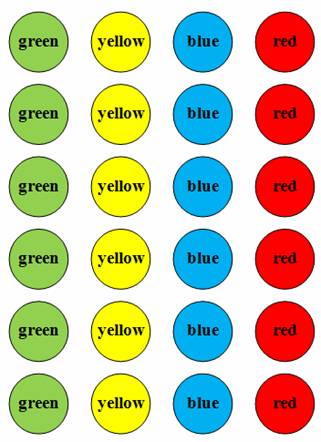
Typical
“Twister” play area
|
|
|
Variations: -
It
would be possible to change the vocabulary on the dots, so that other words
were used -
The
size of the play area can be made smaller or larger -
Any
number of players can play at the same time (depending on the size of the
play area) |
||
|
Red Rover! |
(Preparation: None!)
. |
|
/
body movement / speaking /
outdoors / names
/ |
|
|
Two teams on
opposite sides of a large open room, or outdoors -
Each
team hold hands and make a row on their side of the area One team goes
first: and calls for one player on the other team, for example: “Susan”: “Red
Rover, Red Rover, send Susan right over!” -
Susan
lets go of her team mates and runs toward the other team o If she breaks through their row, then she can take one of the two
people that she broke through back with her to her original team o If she cannot break through their row, she is “caught” and must join the new
team -
The
goal is to get everyone on your
team -
When
one team gets everyone, then they win! (everyone is on that team, so everyone
will win!)
|
|
|
Recognition of key-words or finding
words and objects |
|
Show me! |
(Preparation: make cards, each with a picture or word) . |
|
/
recognize keywords /
body movement / cards with pictures or words / |
|
|
Make many
cards, each with a picture of an object or animal -
Give
one card to each player -
Players
look at their card, but don’t show anyone else -
Then
place their card face down, or hold it against their chest Play: -
Play
music and have everyone move around the room -
Stop
the music and everyone must “freeze” (stand still) -
The
teacher says the name of one of the pictures -
The
player(s) with that picture, turns it over and shows it to everyone - they
get one point! -
as
part of their “prize” they are also free to move (while everyone else is
still still-frozen)! After all the
cards have been named, switch pictures and play again |
|
|
Variation:
Teacher says the name of the category (“animals” “food”) -
Anyone
with an animal picture (or picture of food) turns it over and shows it.. and
also can move |
|
|
Hold it up! |
(Preparation:
make cards, each with a picture or word) . |
|
/
recognize keywords /
understand definitions / body movement /
cards with pictures or words / |
|
|
Similar to
“Show me!” or to “Whack the word” Make many
cards, each with a word (or could use pictures or drawings) Play in teams: Every
team gets a full set of all the cards -
One
player plays at a time for each team (for small teams, the whole team might
play together) -
All
the cards are laid on a desk in front of the player The teachers
calls out a word (for advanced students: the teacher gives a definition of the word) -
Players
look for the card with that word (or with the picture) -
First
player to “Hold it up!”
gets one point for their
team Each team sends
a different player forward to play |
|
|
Variation:
Can separate the board into one area for each team -
write
all the words in each team’s area -
one
player from a each team runs forward and circles the correct word -
first
player to circle the correct word,
gets one point for their
team |
|
|
That’s my word! |
(Preparation: pick a text, write keywords on papers) . |
|
/
recognize keywords /
body movement / cards with pictures or words /
speaking / |
|
|
Find a story
(or other text) for students’ age and skill level Make a list of
“key words” in the text, and write each one on a piece of paper: -
Each
student gets one piece of paper with one word on the paper (or, give students
2 or 3 papers) -
The
teacher reads the story (or other text) -
When
students hear their word, they must stand
up quickly, show their card,
and say the word -
Every
time they correctly hear their word and stand up and say it, they get one point. After playing,
the class can discuss the key words and their meanings |
|
|
Variation:
Each student has several words -
When
a “key word” is read, several students might have that word on their list -
the
first student to stand,
show the “word card” and say the word, gets one point. |
|
|
Grab that word! |
(Preparation: pick a song, bring a music player, put
keywords on papers) . |
|
/
recognize keywords /
body movement / cards with pictures or words / |
|
|
Pick a song
that students will like - Pick out lots of good words from the song -
write
each word on a separate piece of paper -
stick the words all around the
blackboard -
(include
some words that are not actually in the song! = “distracters” = “Red Herrings”) Students play
in teams -
One
person plays at a time for each team (their team can cheer them on) -
Each
team’s current player stands at the front of their line Play a
recording of the song -
When
the players hear a word in
the song that’s on the board, they run
and try to grab that word -
After
a player runs forward once, they go to the end of their team’s line Play the song
several times, or until all the words are taken off the board (except any
“Red Herrings”) -
the
team with the most words, wins (any team grabbing a “Red Herring” loses
points!) |
|
|
Scavenger Hunt |
(Preparation: pick “things” to find and where to find
them) . |
|
/
recognize keywords /
body movement / |
|
|
Basic Game:
Each team gets a list of things to find -
Team
that finds the most things on the list (within a time limit) wins! |
|
|
Variations:
Can “hunt” from various sources: -
Hunt
through the items in the room,
or within the building, or in
sight through the windows -
Hunt
through a written text -
Hunt
through the words of a song -
Hunt
through a video (words and
pictures) |
|
|
Notes:
Categories of things to find: -
Objects:
Find particular objects, or pictures or verbal descriptions of the
objects. -
Information: Ask players to find facts or figures. These facts may be verbal or
visual and can include things spoken, information written in charts or text. -
Counts:
Count the number of times a certain word or picture or object or idea is
appears (for example, the number of times someone says a particular word, the
number of people wearing a certain color, the number of a particular type of
object, the number of times that someone does a particular action. -
Scenes:
Find pictures or descriptions of particular scenes, for example a “love
scene”, or a particular location (eg. a river or a famous city) or some sort
of social activity (eg. a picnic, a speech). -
Activities: Find examples of actions, for
example playing sports or eating or singing a song, anything that can be
described with a verb. -
Spoken Acts: Find examples of certain kinds of speaking (eg. inviting, refusing,
requesting, making an introduction, apologizing, saying “hello”). |
|
|
Identifying differences |
|
What changed? |
(Preparation: None!)
. |
|
/
categories of vocabulary / speaking
/ writing /
body movement / |
|
|
Two or more
students go out of the classroom -
While
students are out, other students
change things in the classroom o For example: change coats, sit in
different places, move things o students in the classroom write a list of everything
that has changed Then the students come back into the class
and try to guess everything that has changed -
the
student who guesses the most things wins |
|
|
Find the differences |
(Preparation:
find or make 2 pictures which are
almost the same) . |
|
/
speaking / descriptions /
questions / |
|
|
Find or draw or
make 2 pictures which are exactly the same except for 7 details (make several
pairs) -
photocopy
the 2 pictures on separate sheets of paper Every student
finds a partner -
Give
one of the pictures to each person in each pair -
Students
should NOT show their pictures to each other (players should sit
back-to-back) -
Players describe their 2 pictures to each other -
Players
can ask questions and discuss their 2 pictures with
each other (but cannot look!) -
They
try to find the differences between the pictures without looking at each
other’s pictures -
First
pair to identify all the differences between the pictures wins |
|
|
Variation:
Play several times with several different pairs of pictures -
each
time you play, everyone finds a new partner -
when
a pair of students win,
they both get one point -
then
next game, they both find new partners, but each student keeps their own
number of points -
after
several games, always changing partners, count up which student has the most
points! |
|
|
Giving directions |
|
Pin the tail on the
donkey! Where is his nose? |
(Preparation: None!)
. |
|
/
speaking / spatial directions / body
parts / drawing
/ |
|
|
Can use this
for learning “Body Parts” - any body
part can be used, and must be put in the correct place One player is blindfolded (or wears a funny
mask) -
the
player tries to draw a body part on the board in the correct place -
other
players on the same team shout
directions telling them where to go and where to draw Any body parts
can be used, any sorts of animals -
for example:
draw a nose on a face, put a tail on an animal, etc. -
The
person who does it most accurately,
wins a point for their team |
|
|
Addition:
Have players draw the body parts like various animals: --- Draw feet
like a horse --- Draw a head
like a snake --- Draw
ears like an elephant |
|
|
Variation:
Can prepare pictures of body
parts, which players stick up on the board |
|
|
Find the treasure! |
(Preparation:
plans for the map and what will be found) . |
|
/
speaking / spatial directions /
outdoors / |
|
|
Draw a map on the board (can put up pictures or
photos of things in the map) Or use the
classroom or outside area as the map -
play
in partners or small groups -
One
person in each group (the “blind
person”) puts on a blindfold (a funny mask?) -
The
teacher or host decides: o starting
location o ending
location (location of some “hidden treasure”) All teams can
play at the same time (or play one team at a time, and give each team a time
limit) -
The
“blind people” start at the starting location -
Other
players give directions to the
“blind person” on their team; where to walk, how far, turns, etc. -
The
first “blind person” to get to the end, and find the treasure, wins |
|
|
Note: Can be played on the board, by “walking with your hands” through
a map drawn on the board |
|
|
Repetition: Drilling, Clapping, Chanting |
|
Clapping Syllables |
(Preparation:
useful words or sentences to clap) . |
|
|
/ speaking /
body movement / pronunciation / |
||
|
Can be used
anytime when working on pronunciation in words or sentences (or poems, songs) -
Clap
hands together with the class while saying the syllables in a word or
sentence -
Give
a new word or sentence and ask students to clap the syllables while they say
it -
Identify
any extra claps (that should not be there) or any syllables that are not
getting clapped Finish by
reading a text, or singing a song or a chant, with everyone clapping together
while also speaking |
||
|
Game play:
make several teams (3-5 in each
team) -
Each
team gets a different word (for more advanced players: an entire sentence) -
Teams
have a time-limit to rehearse clapping pattern for that word (or sentence) -
Then
each team performs: --- clapping while also speaking
(the word or sentence) o If the pattern is correct, they get one point o If the pattern is not correct, they lose a point! Have several
rounds so teams have several chances to get points team
with most points wins |
||
|
Variation 1:
Several players act as “Judges” and award points for: |
||
|
-
Accuracy points: -
Stylistic points: |
--- correctness
of the clapping pattern --- interest,
creativity of the clapping performance |
|
|
Variation 2:
Show teams a list so they can pick the word
(or sentence) they will clap -
each
word (or sentence) will have a “degree of difficulty” -
The
points for “accuracy” and “Style” will be multiplied by
the “difficulty” for the
total score! |
||
|
Bigger & Bigger!
|
(Preparation:
useful words or sentences) . |
|
/
speaking / body movement /
pronunciation / outdoors
/ |
|
|
Teacher writes
a word or short sentence on the board and reviews correct pronunciation Basic activity: -
Students
start by getting their bodies very tiny
and whispering the word very softly -
Gradually
each time they say the word they move
from tiny to bigger -
Finally
each time they say the word they move from quiet and tiny to as big and yelling the word |
|
|
Bigger & Bigger!
|
(Preparation:
useful words or sentences) . |
|
/
speaking / body movement /
pronunciation / outdoors
/ |
|
|
Bigger & Bigger!
--- Game play |
|
|
Several teams
(3-5 in each team), each team practice together -
Have
3-4 other players act as “Judges” |
|
|
Game 1:
All teams perform at the
same time: -
Judges
give a new word (or sentence) -
Judges vote, and give prizes for Three different categories: 1) Team that can get the biggest and say the word the loudest 2) Team that can get the smallest and say the word the quietest (but still be heard) 3) Team that has the largest difference between being small and quiet to being
big and loud |
|
|
Game 2:
Teams compete Round - by-
Round: -
Two
teams compete against
each other at each round -
The
victor moves on to the next round -
For
each new competition, the judges
give a new word (or sentence) for the teams to say Judges pick
which team has the largest
difference between getting small
to large and quiet to loud -
After
all the teams have competed once, then the winners of the 1st
round compete against each other -
Finally
there are “play offs” and
one team emerges as the final victor! |
|
|
Variations:
For a large open room, of for outside: -
Run across the room (or across the outdoor play area) while
getting bigger and louder -
Reverse the task:
Start loud, then run and get quieter and smaller Judges can call out the word (or sentence) to
be said, and award prizes for each competition. |
|
|
“Beep” game / Number beep game / Alphabet beep game |
(Preparation: None!)
. |
|
|
/
speaking / numbers
/ alphabet /
passing a ball or toy / |
||
|
Players stand
in a row Every 4th number, instead of saying the number, the
student says “Beep” |
-
1st
student says “1” -
2nd
student says “2” -
3rd
student says “3” -
4th
student says “Beep!” -
5th
student says “5” . . . . keep
counting etc.... |
|
|
-
Then
the next student continues with the next number (NOT the replaced number) -
If
a player hesitates too long,
or says the wrong number,
.... they lose one point
(or sit down) -
Begin
counting again at “1” Last player
to be standing, or with least “points” is the Winner! |
||
|
Variations: Play
the game with the Alphabet. -
Pass a ball (or bean-bag or soft toy) to the next
player when it is their turn |
||
|
Speed-naming! |
(Preparation: list of new vocabulary) . |
|
/
speaking / categories of vocabulary /
pronunciation / |
|
|
Use to help
learn any new vocabulary -
Write
the new vocabulary words on the
board (or put up pictures) -
demonstrate
the pronunciation of each and have students repeat the names -
practice
by pointing at each word or picture, and having students say the name -
then
point at the words or pictures in random order -
randomly
point at words or pictures faster
and faster while students say the names |
|
|
Game play: -
either
play in groups (for a large class) or every student plays individually (for a
small class) -
give
each group (or each person) a short time-limit -
point
randomly at the different words or pictures the group (or
person) who can correctly say the
most names within the time limit... wins! |
|
|
Speed-naming: Punctuation |
(Preparation: None!)
. |
||||||
|
/
speaking / categories of vocabulary /
pronunciation / punctuation
/ |
|||||||
|
Write the punctuation signs on the board
(depending on level, choose how many signs to use) -
Review
the names of the signs (don’t
write the names, just write the signs) |
|||||||
|
.
period |
, comma |
?
question mark |
! exclamation point |
‘ apostrophe |
: |
; semicolon |
|
|
-
practice
by pointing at each sign, and having students say the name -
then
point at the signs faster &
faster and in random order
while students say the names |
|||||||
|
Game play:
Play in groups (large classes) or students play individually (small
classes) -
Point
at signs in random order, very quickly, giving each group a short time-limit the group (or
person) who can correctly say the
most names within the time limit... wins! |
|||||||
|
Relaying information from one to
another |
|
What’s on your back? |
(Preparation: None!)
. |
|
/
alphabet / writing
/ recognize words /
body movement / |
|
|
Similar to
“telephone” but much simpler (one letter or one word) and writing instead of
speaking. -
Players
sit in lines -
Players
at the back of the line see a Letter
or a Word -
Players
“write” (draw, trace) that letter or word on the back of the player in front
of them. -
Continue
down the line -
The
player in front writes the letter or word on the board or on paper. -
First
team to write the correct letter
or word wins. The player at
the front of the line then moves to the back for the next round. |
|
|
Variation:
Write a letter on the person’s back -
Then
the person at the front must run to the board, and write a word that begins with that letter Make it harder? -
The
person at the front runs to the board and writes a word that ENDS with that letter! |
|
|
Variation:
Players write the letters or word with their finger in the air -
Other
players watch the “Air Writing”
and try to guess the letters or words |
|
|
Variation:
Write a short sentence (on your friend’s back, or in the air) and pass
it down the line |
|
|
Telephone! Whisper Circle! |
(Preparation:
write sentences on cards) . |
|
/
reading / speaking
/ listening /
sentences / |
|
|
Divide class
into teams of 7-10 people in each team -
the
1st person from each team comes to the front. -
show
them a card with a sentence and say “Go!” -
as
soon as they can, the players run to the back of their team’s line §
the
1st player in each group whispers the sentence to the the 2nd
player §
the
2nd player whispers it to the 3rd player, etc. -
Each
person can whisper the sentence
only once -
The
last person in each group
goes to the front and says the sentence to the teacher -
(or
could run to the front and write it on the board, or write it on paper) §
If
it is not correct, then the 1st person begins again, whispering
the sentence to person #2 -
The
first group to say the correct sentence wins. |
|
|
Note:
Have student “Judges”
check the papers and say who gets the sentence first |
|
|
Relay the story! Dictation! |
(Preparation:
put story, poem, etc. on papers) . |
|
/
speaking / listening
/ sentences / |
|
|
Select a short story, poem, or anything - can be picked for target-language
being taught. -
Teams
of 2-6 people (variation: could be
more people - but every team with same number) §
the
1st player in each group reads
the writing, then tells it to the the 2nd player §
the
2nd player tells it to the 3rd player, etc. §
the
final player hears the words (story, poem, sentence) and writes it down Players can
repeat the story as many times as necessary. -
If
a player has questions, they can ask the player who is telling them the
story. Student “Judges” look at the writing
and point out any errors -
The
last person must ask the previous person how to correct errors -
Questions must be relayed back to the 1st
person, who gives an
answer and sends it back -
First team to correctly write the words (story, poem, sentence) wins! After each
play, the Final Player
should go to the beginning, becoming the 1st
player for the next game |
|
|
Strategy for play:
The story will be too long
to remember and send all at once, -
so
the 1st player will need to decide how much to tell to the 2nd player each time. o could send one or two words at a time (slower
- but maybe more accurate) o might try to send 2 or 3 sentences at a
time (faster - but maybe more errors) |
|
|
Easy variation: Make it very simple,
just one sentence, or just one word for beginners -
just
use 2 people, and let the “reader”
talk direct to the “writer”,
and also see what they write |
|
|
Hard variation: Use a long complicated story -
Require
correct punctuation in the writing -
Use
several people in each team (more people to pass the message to) |
|
|
Variation:
“Telephone” One short message is passed all at once |
|
|
Guess!
- a word - an object - a person - a sentence - a story... |
|
Guess the word! |
(Preparation:
pictures or drawings on cards) . |
|
/
categories of vocabulary / pictures & drawings /
recall words / |
|
|
Teacher shows a
picture or drawing of an object: students try to recall the word -
Players
can either write the word,
or stand up if they know it -
Players
who correctly recall the most words.... win! |
|
|
Notes:
The teacher can make it more exciting for elementary learners by
increasing anticipation: -
Ask
“What is it?” before showing the picture o Then slowly reveal the picture, show
only part of it, or show it quickly & hide it again |
|
|
I spy with my little eye! I hear with my little ear! |
(Preparation: None!)
. |
||
|
/
categories of vocabulary / recall words / |
|||
|
A player picks
something that can currently be
seen or be heard |
|||
|
|
Basic phrase for the clue |
example clues |
|
|
and gives a clue: |
“I spy with my
little eye....” “I hear with my
little ear....” |
“... something
that begins with the letter W” “... something
that is red.” “... something
beginning with the letter C” |
|
|
Any types of clues can be given, depending on rules
decided for that particular game. Answers and
clues could also be phrases: “....
something with 2 words beginning with B, D”
(brown dog) |
|||
|
First player to
guess gets a point, and
becomes the next person to say “I spy with my little....” |
|||
|
Fly Swatter! / Whack the word! |
(Preparation:
words to be “whacked”) . |
|
/
body movement / categories of vocabulary /
recall words / recognize words /
pictures & drawings / |
|
|
Basic game:
Play with 2-6 teams (or 2-6 people) -
a
large number of words are placed
somewhere in the room -
One
player comes forward from each team -
players
get some sort of “clue” for
a particular word -
players
try to “whack” the word
(find it, hit it, circle it, draw a line through it, etc.) -
First
player to “whack” the correct word, gets a point. The next player
comes forward from each team |
|
|
Variations:
- a large number of words are placed somewhere in the room: -
the
words could be: §
write
all the words on the board,
scattered about randomly, or §
each
team gets one part of the board,
all the words are written in each team’s part of the board, or §
words
are written on cards and stuck to
the board (so players can grab them) §
words
are written on cards & laid out face
up on a table (so players can grab them) §
words
are written on cards & laid face
down on a table (players try to remember where the words are) §
words
are scattered about the room
in many places (players run in many directions to find words) §
instead
of using words, use pictures
on the board or in the room, students find the correct picture Note: there should be lots of words (or
pictures), so the correct answer is not obvious |
|
|
Variations:
- One player comes forward from each team: -
Players
might: §
sit
or stand facing away from
the board (where the words are written) §
sit
or stand facing the board
(for beginning students) §
stand
in the back of the room
(and have to run forward to “whack” the word) §
stand
on one side of a line, with
words on the other side (must cross the line to “whack” a word) §
or
stand at one side of the room,
with the words at the other side |
|
|
Variations:
- players get some sort of “clue” for a particular word: -
The
teacher might: §
say the word, or §
describe the definition of the word (in English,
or in students’ native language), or §
draw or show a picture representing the word, or §
show real objects or toys that represent the word §
act-out, mime the word |
|
|
Variations:
- players try to “whack” the
word (that is, find the word in some way): -
Players
might: §
hit the word with a “fly swatter” or rolled up
paper, or a stick or ones hand §
draw a line through the word §
erase the word §
put a hand over the word §
grab a card with the word written on it |
|
|
Variations: First player to “whack” the correct word,
gets a point: -
Other
options: §
each
player only allowed 1 “whack”,
if the 1st one is wrong,
cannot “whack” another word §
if
no one “whacks” the correct word, then no one gets any points |
|
|
Simple variation:
-
use
“concrete” nouns for the
words |
|
|
Advanced variation:
-
use
“abstract” concepts for the
words |
|
|
Fly Swatter! / Whack the word! -- Categories! |
(Preparation:
words to be “whacked”) . |
|
/
body movement / categories of vocabulary /
recall words / recognize words /
pictures & drawings / |
|
|
Variation of “Fly swatter”/ “Whack the word” -
“Vocabulary”
(words to be “whacked”) consists of Categories, Contexts, or Scenes. For example: -
Where
is it in the house? (Kitchen, Bedroom, Bathroom, Living room, Garage, ....) -
Where
is it in the city? (Hospital, Police station, Library, Hotel, Restaurant, Gas
Station. . . ) -
Where
is it in the school? (Classroom, Hallway, WC, Library, Teacher’s Office . .
.) Teacher “clues
a word” Students run to
the board and “whack” the correct
category or context or location for that word |
|
|
Duel /
Bang Bang |
(Preparation:
list of words and clues) . |
|
/
speaking / recognize words /
categories of vocabulary / |
|
|
Divide the
class into teams: one player from each team comes to
the front -
give
an obvious “clue” for a
word, for example: --- show a picture ---
define the word --- say
the word in the student’s mother
tongue -
The
first player to say the correct word wins the duel (can say “Bang bang!”-the
others are killed) -
If
they say an incorrect answer, they are also “killed” (gun backfires, misfires) -
The
“killed” players are replaced by
others §
one point for saying the correct answer first §
five bonus points for winning 4 times in a row -
After
4 wins in a row, that player should be replaced (to give everyone a chance to
play) |
|
|
Variations:
Instead of teams, all players could play for themselves |
|
|
Extras:
Play the game very fast, players must come and go and answer quickly -
have
an extra person who is “Sherriff”
and confirms who lives and who is killed |
|
|
Twenty Questions! |
(Preparation: None!)
. |
|
/
questions / speaking
/ categories of vocabulary / |
|
|
First
one member of the class chooses a
word, an object, an occupation, or an action, etc.. Then
members of the class try to guess -
Players can ask
questions which can be answered either: --- “Yes” --- “No” Variation:
answers of: “Maybe” or “Sometimes” -
“Guessers” only get 20 questions to guess §
If they guess correctly within 20
questions, then the guesser gets
one point §
If they cannot guess correctly within
20 questions, then the person
giving answers gets one point! |
|
|
Three Lives! |
(Preparation: None!)
. |
||
|
/
questions / speaking
/ categories of vocabulary / |
|||
Basic game:
Same as “Twenty
Questions” (or can be used in any
guessing game) ... Except:
-
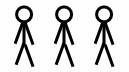
Each player
(or team) gets “Three
Lives” (shown by 3 drawings of bodies
on the board)
|
|||
|
|
|
|
|
|
If a question or guess, is
answered “No” one of the “three
lives” is lost (cross it out, draw a sad face) -
When all three
lives are lost, then that team is “out” |
|||
|
Hangman! |
(Preparation: None!)
. |
|
|
/ questions /
speaking / categories of vocabulary /
spelling / |
||
Basic
game:
One player (the “Writer”) thinks of a word and can tell the category (eg. “Animals”)
-
writes a series
of lines: ___ ___
___ to show the number of letters
-
“Guessers” (or teams) take turns guessing the letters (Is there a “B”?)
§
Whenever
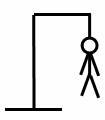
the answer is “No” - one more line gets drawn on the
hanging man §
Players get excited as they see
themselves come closer and closer to being hanged! -
If the guess is correct, then the Writer puts that letter in one of the
lines:
. C
. . . . .
-
Guessers keep guessing letters until either: §
They
correctly guess the whole word
(they “win” and get one
point!) §
They
use all their guesses, and so are
“hanged” (they lose a point!) |
|
|
Game play: Writer vs. Guesser
-
One team or person is the “writer” and the other team or person is the “guesser”.
§
If
the “Guesser” correctly guesses before being hanged, the guesser gets one point §
If
the “Guesser” gets hanged before correctly guessing, then the writer gets one point |
||
Game play: Guesser vs. Guesser
-
Two or more teams (or people) all try
to guess the word
§
The
team or player who guesses
correctly first, wins and gets the point §
If all the teams get hanged, then
no one gets any points for that round |
||
Variation: Hangman can be
used in any game when players make guesses or ask Yes / No questions
-
Hangman is used as a fun way to “count” the number of incorrect guesses
(“No” answers)
-
Once a player reaches the maximum
number of “No” answers allowed:
§
They lose that point (punished in
some fun way!) §
They are “out” (remaining players keep
playing, till only one remains) §
Or the point goes to the other player |
||
|
Variation: There can be 10 lines to draw for the “hanging man” (10 questions
answered “no”) -
but any number of lines can be used
(add lines for feet, fingers, face, etc.) |
||
|
What are you talking (writing) about? |
(Preparation: None!)
. |
|
/
writing / grammar
/ sentences /
adjectives & adverbs / descriptions / |
|
|
Everyone pick something in the classroom to
describe -
Write a description of that thing. After finishing, find a group of 3 (or
more) -
One person reads their description, and others try to guess what you
are writing about. -
The
first to guess in your
group wins one point (then another person read their paper) -
After
everyone has read their paper, find new groups, read papers, and winners get
points. -
Continue
till everyone has heard all the descriptions from every player. -
After
all groups are finished, the player with the most points is the grand winner! |
|
|
Variations:
Descriptions can be anything anywhere
in the school, or anything in
the world |
|
|
Describe your friend! |
(Preparation: None!)
. |
|
/
writing / sentences
/ adjectives & adverbs /
descriptions / names
/ listening for key words / |
|
|
Everyone find a
partner and everyone write a
description of their partner -
After
finishing, share the writings with partners and work together to correct any
mistakes. -
Put
all the writings together (randomly, with no names) -
Each
player randomly picks one and reads
it to the class, the first player to “guess who” gets one point.
-
Continue
through all the descriptions, the player with the most points is the grand winner! |
|
|
Variation:
Instead of writing a description, make a drawing of your friend. |
|
|
Guess your classmates! |
(Preparation: None!)
. |
|
/
names / writing
/ listening for key words /
descriptions / |
|
|
Every student
needs a piece of paper -
On
the paper: 1) write their name, 2) write something about themselves. §
It
should be something that is OK to read out loud to the whole class, for
example: --- something about your family ---
what you did on your last holiday ---
your special talents -
Don’t show it to anyone, and also fold the paper so no one can see it The teacher
collects all the papers -
The
teacher reads each paper one by one -
Students
listen, and make a list:
#1, #2, #3.... etc. o write the name of the classmate who they think wrote each paper At the end - the student with the most correct guesses,
wins! |
|
|
The Name Game! |
(Preparation: None!)
. |
|
/
names / speaking
/ questions / |
|
|
After students
have learned each other’s names (English Names) -
One student sits in front of the class, facing away from the other students
(toward the board) The teacher picks
one student in the class -
That
student says “My name is _____” (they can say their name, or can say anyone’s
name) -
The
student in the front must say either: |
|
|
§
“Yes,
it is _____” §
“No,
it isn’t _____” |
(this answer
might be correct, or incorrect) (this answer
might be correct, or incorrect) |
|
-
If
the guesser is correct,
then he / she gets to stay in front -
If
the guesser is wrong, then
the student who fooled him / her gets to come to the front |
|
|
Variation:
Some games assume that a student in front of the class wants to stay there -
But
for many classes, being in front feels more like punishment! (they would
rather sit down!) Alternative
result for this game: -
If
the player in front is correct,
then the student who tried to fool him / her must come to the front -
If
the player in front is wrong,
then he / she must stay in the front |
|
|
Who is it? “If they were a __, then what __ would they
be?” |
(Preparation: None!)
. |
|
/ names
/ modals - conditionals - subjunctive mood / speaking
/ questions / categories of
vocabulary / |
|
|
One person (or
a small group) leave the room -
The
rest of the class picks one person to be “it” (that person should be
present in the room) -
The
other person or people come back into the room - their goal is to guess who “it” is. They ask the
class questions to get clues about who “it” could be -
questions
use categories, for
example: o fruit, vegetable, sweet, weather,
flower, city, food, animal, car -
Questions
use the subjunctive mood (conditionals) o “If this person were a ____ what kind of ____ would he or she be?” for example: o “If this person were a flower, what kind of flower would he or she be?” Anyone in the
class can answer: o “If this person were a flower, he or she would be a
red rose.” (encourage students to add adjectives to the kind of flower:
beautiful, wilting, etc...) Allow the “guessers” either a time
limit, or a limit to the number of questions (20 Questions!) -
then
they must guess - if they are right, they win and get one point! New people (or
small group) go out of the room and play again |
|
|
Who are you talking about? |
(Preparation: None!)
. |
|
/
names / speaking
/ questions /
descriptions / drawing
/ |
|
|
Divide players
into groups (3-6 in a group) -
The
“interviewee” verbally describes
someone who everybody knows -
All
the other players draw the person,
according to the verbal description -
Anyone
can ask the interviewee questions
about the description (for example, any details) -
After
the description is finished, everyone shows their drawings and tries to guess
who the person is. First person to guess, wins a point. -
Play
again with a different person as the “interviewee” |
|
|
Variation:
After the drawings are finished, trade
the drawings with another group -
Then
each group tries to guess “who it is” from drawings made by a different group (in this case, the guessers
only see the drawings, but have not heard the verbal description) |
|
|
Police sketch artists! |
(Preparation: None!)
. |
|
/
names / speaking
/ questions /
descriptions / drawing
/ |
|
|
Divide players
into groups (3-6 in a group) -
One
person is the “Witness”
(they saw a crime or some special event) -
Other
players in the group are “Sketch
Artists” -
The
witnesses: o act like
they do NOT know the name of “who did it”, o do not know who they are o do not know if they are male or female o describe the person “who did it” (someone present in the
class, but not in the group) -
The
sketch artists: o draw pictures according to the witness’s description o can ask the witness questions
about details for their drawings After sketch
artists have finished their drawings: o Trade drawings with another group
(everyone gets drawings they have not seen before) Players are
now: “detectives” talk to
other players in the class asking: “Have
you seen this person?” o If someone recognizes the person in the
drawing: §
The
detective takes this suspect to the original
witness and ask “Is this who
you saw?” o If it is the right person: then the 1st detective to find the
person gets one point! After everyone
has been identified, change roles and play again. |
|
|
Who are you? What
are you? (changing partners) |
(Preparation: None!)
. |
||||
|
/
speaking / categories of vocabulary /
questions / |
|||||
|
Each person in the class picks something / someone “to be” (write this on a small card or paper) Examples: |
|||||
|
- a famous
person |
- an object |
- a type
of job |
- an animal |
- a kind
of food |
|
|
Everyone find a partner,
and try to guess who or what that person is Variation 1: ask yes / no questions (or yes / no / maybe questions) Variation 2: ask open-ended questions (make for
more conversation) After guessing who your
partner is, then: -
switch cards with your partner (everyone gets a new card!) -
find a new partner (everyone is now
something different!) |
|||||
|
Guess Who! Guess What!
(groups) |
(Preparation: None!)
. |
|
|
/
speaking / categories of vocabulary /
questions / |
||
|
One person is “It” - that person picks a thing (or a person) “to be” -
a famous person, an object, a type of job, an animal,
etc. (decide which category will be used)
Players take
turns: ask a yes / no question -
if
the answer is “yes” that guesser
can ask another question -
if
the answer is “no” then it
is the next player’s turn -
first player who guesses correctly (Who you are, or What you are) wins -
The
player who wins, gets 1
point (for themselves, or for their team) and they are now “It” |
||
|
Variation:
Questions could have 3 possible answers: “Yes”, “No”,
or “Maybe” (“sometimes”) |
||
|
Variations: Can require certain types of words
in the yes / no questions: -
nouns (Are you an actor), adjectives (Are you tall?), noun with adjective (Are you a
tall man?) -
modal verbs (Should you always get up early?)
(Could you make a lot of money?) |
||
|
Can be played in teams: -
One
player is “It” (thinks of something “to be”) -
For
example, 3 teams try to guess: o 1st player from team #1, ask
yes / no / maybe question o 1st player from team #2 ask a
question o 1st player from team #3 ask a
question o then 2nd player from team #1
ask a question, etc. going from team to team |
||
|
Can be played in small groups: one
person is “It” and other players each take turns asking questions |
||
|
Variation: Have students generate vocabulary
(word-lists) to limit the possibilities of what “It” is: -
students
write lists of words in these categories
as other students call them out, for
example: |
||
|
types of animals famous people |
types of jobs abstract nouns (advanced students) |
|
|
Beginning students: Limit the possibilities: The “thing” is a concrete noun eg. an object in
the room, something that can be seen from the window |
||
|
Advanced students: Open the possibilities: The “thing” is an abstract noun (peace,
confusion, excitement, anger) |
||
|
Who are they? What
are they? ( ½ & ½ ) |
(Preparation: None!)
. |
||
|
/
speaking / categories of vocabulary /
questions / |
|||
|
Divide the class in half: -
Players from ½ of the class each
pick something or someone “to be” -
Players from other
½ of the class ask questions to
try to guess who the other players are o
Questions
can only be answered either: “yes”, “no” or “sometimes” Examples: |
|||
|
-
Fans
or Reporters -
Hungry
people -
Travelers -
Hunters
-
People
with no job |
look for look for look for look for look for |
-
famous
people -
types
of food -
famous
cities or countries or places to visit -
animals -
kinds
of work or job |
|
|
Each “Guesser” must: -
have a piece of paper -
guess who /
what each person from the other ½ of the class is -
When guessing correctly,
write down each person’s name, and who / what they are First person to guess who every
person is from the other ½ of the class, wins! |
|||
|
Who am I? What am I?
Where am I? |
(Preparation:
cards to stick on players foreheads) . |
|
/
speaking / categories of vocabulary /
questions / |
|
|
Each player
gets a piece of paper taped on
their forehead (or on their back) (the person does not know who they are, but everyone else knows
who they are) -
name
of a famous person (who am
I?) -
name
of an object or food or animal, etc... (what am I?) -
name
of a location (where am I? They can ask
questions about themselves (only with answers: yes / no
/ maybe or sometimes) -
Ask
a question -
if
the answer is “yes” then
can ask another question -
if
the answer is “no” then
your turn is over, and the other person starts to ask questions The last
person to figure out who they are is the loser! (“Punish” them in some fun way!) |
|
|
Variation:
this can also be played using “Twenty
Questions” or “Hangman” -
The
player must guess who they are within 20 questions, or before getting hanged,
or they lose! |
|
|
Hot Seat! |
(Preparation:
pick words to be guessed, and any “taboo” words) . |
|
/
speaking / categories of vocabulary / |
|
|
Divide class
into teams: -
Each
team sends one player forward who is the “Guesser” -
The
Guesser sits facing away from the board (CANNOT LOOK AT THE BOARD!) -
Teacher
writes a word on the board
(variation: put a picture on
the board) |
|
|
Teams take
turns giving clues to that
team’s guesser who tries to
guess the word: §
Team #1 gives 1 clue and their guesser
in front who gets 1 guess §
Repeat for each team: Team #1, Team #2, Team #3, then start
again: Team #1 etc... First team to guess the word wins one point (then change players in front, and play
again) |
|
|
Variation:
Clues must consist of just one word, or one full sentence,
or a particular type of grammar |
|
|
Variation:
Set a time limit for
how long a team can take for: Clue
+ Guess |
|
|
Variation:
Allow team members to discuss their clues (team work) -
or
make each person think of their own clue |
|
|
Variations, possible
rules: -
Do
not allow body movements as the clue (“speaking only” practices verbal
skills) -
Or,
Play the game using ONLY body movements as the clue -
Clues
cannot say how many syllables
are in the word or what letter
the word starts with. |
|
|
Variation:
include “Taboo” words - words that CANNOT be used in the clue -
Clues that would be too easy (eg. “school”: Cannot use: “teacher, students,
desks, test” as clues) |
|
|
Pictionary! Charades!
(basic game) |
(Preparation: None!)
. |
||||||||
|
/
categories of vocabulary / recall words /
body movement / drawing
/ |
|||||||||
|
Basic game:
Organise vocabulary into categories, for example: |
|||||||||
|
jobs |
animals |
food |
actions |
places |
abstract nouns |
famous people |
names of songs or movies |
||
|
“Guessers”: try to guess a word
or a short phrase §
Guessers can make as many guesses as they want,
and can ask “yes or no” questions “Performers”: can only say
“Yes” or “No” and also can either: |
|||||||||
|
o act-out
the meaning or actions of the word or phrase |
= “Charades” |
||||||||
|
o draw a picture of the word or phrase |
= “Pictionary” |
||||||||
|
Variations: Many variations!! (see examples below!) |
|||||||||
|
Pictionary! Charades! -- Team 1 versus Team 2 |
(Preparation: None!)
. |
|
/
categories of vocabulary / recall words /
body movement / drawing
/ |
|
|
Team #1
picks the word or phrase (within a category of vocabulary) for Team #2 -
The “performer” from Team #2 sees
the word or phrase. -
The “guessers” from Team #2 do
not see the word or phrase. §
If Team #2
guesses the word or phrase within
the time limit, then they win. §
If Team #2 does not guess the word or
phrase within the time limit, then Team
#1 wins. Then switch roles: Team #2 picks the word or phrase (within
the same category) for Team #1 |
|
|
Pictionary! Charades! -- “First team to guess!” |
(Preparation:
words or phrases in categories) . |
|
/
categories of vocabulary / recall words /
body movement / drawing
/ |
|
|
Any number of teams The teacher (or hosts of
the party) pick a word or phrase
(within a category of vocabulary) -
The “performers” (1 from each team)
see the word or phrase, but the “guessers”
do not see it -
Each
“performer” acts-out
(Charades) or draws (Pictionary) for their own team -
The
first team to guess the
word or phrase is the winner Then each team picks a
new “performer” for the next word or phrase. |
|
|
Pictionary! Charades! -- “How
many can you guess!” |
(Preparation:
words or phrases in categories) . |
|
/
categories of vocabulary / recall words /
body movement / drawing
/ |
|
|
Any number of teams: The teacher (or hosts of
the party) pick several words or
phrases (within a category) -
Each
team randomly picks a “category”
of words / phrases (The
Categories, and group of words or
phrases will be different for each team) -
Each
team picks one “performer”
(who sees all the words or phrases) -
Each
team tries to guess as many words or phrases within a time limit o Team #1 goes first, trying to guess as
many words or phrases within a time limit o Team #2 goes next, with the same
amount of time o Team #3 etc... §
(or,
perhaps all the teams can be guessing at the same time) The team with the most
correct guesses within the time limit wins. |
|
|
Pictionary! Charades!
“Who guesses first?” |
(Preparation:
words or phrases in categories) . |
|
/
categories of vocabulary / recall words /
body movement / drawing
/ |
|
|
Whole class together -
One performer comes to the front
and either: §
draws on the board
(Pictionary) or §
acts-out the word (Charades) -
The whole class
tries to guess the word o
The first guesser to get the correct
word or phrase wins 1 point o
The performer also gets 1 point if
the word was guessed within a time limit. |
|
|
Sentence Charades! (or Pictionary) |
(Preparation: None!)
. |
|
/
sentences / grammar
/ body movement /
drawing / |
|
|
A variation of Charades (or
Pictionary) but the thing to be guessed is an entire sentence -
List
types of words to be used (eg:
verbs, nouns, adjectives-adverbs, prepositions, conjunctions) o Decide on certain requirements for the
sentence, for example: |
|
|
-
tense
(past, present, future, etc) -
how
many verbs |
-
how
many words -
if
there is an “object” |
|
Play the same
as ordinary “Charades” or “Pictionary” -
Players
make their own sentences to
use as the “thing to be guessed” -
The
“guessers” must try to
guess the entire sentence |
|
|
Adjective Charades! (or Pictionary) |
(Preparation:
cards with adjectives and animal names) . |
|
/
body movement / drawing
/ adverbs & adjectives /
animals / |
|
|
Each player randomly
picks: -
a
piece of paper with an adjective
written on it -
a
piece of paper with the name of an
animal written on it The player
either performs (Charades)
or draws pictures
(Pictionary) of the “Adjective” + “Animal” -
Other
players (“guessers”) try to
guess both: The animal and
the adjective -
Each
person gets one point for
each correct guess! |
|
|
Variation:
Guessers must guess using a full
sentence containing the animal name and the adjective. |
|
|
Variation:
Use only “past participle
adjectives” (excited, interested, bored) -
showing
how verbs can be turned into adjectives. |
|
|
Variation:
Use only adjectives that can
be changed into adverbs by adding “-ly” (happy -> happily) -
Then
play “Adverb Charades” right after this game. |
|
|
Adverb Charades! |
(Preparation:
cards with adverbs) . |
||
|
/
body movement / adverbs & adjectives /
commands (imperative mood) / |
|||
|
Each player
gets a piece of paper with an adverb
written on it (don’t show the paper) -
The
class tells the student to do any activity they want to see, for example: |
|||
|
o Pretend
activities: or o Real
activities: |
- “Drink a bowl of soup.” - “Open a door.” |
- “Cook dinner.” - “Write on the board.” |
|
|
The player does
these activities, using their
adverb -
Members
of the class try to guess the adverb -
Each
person gets one point for
each correct guess! |
|||
|
Note:
When the students in the class tell the “performer” what to do: -
they
must use “imperative mood”
(“Tell a story.” “Ride a bike.”
etc...) -
If
they don’t use it, they can be “punished” in some fun way (lose a point, do a
dance etc.) |
|||
|
Do it with feeling! (Charades) |
(Preparation:
cards with verbs and adjectives) . |
|||||||
|
/
body movement / speaking
/ adjectives & adverbs /
sentences / |
||||||||
|
Prepare 2 vocabulary lists (write each
word on a separate card so it can be randomly selected) 1) Actions (verbs) that can end with -ing (dancing, sleeping,
walking....) 2) Feelings (adjectives) (angry, sad..) that can be changed into adverbs by adding -ly |
||||||||
|
Play in teams: Each team sends one player
to the front -
Randomly
select 2 cards (1 action
& 1 feeling) -
All
the players in the front see the same 2 cards -
All
the players perform the action with
the feeling (they all do it
together, so feel less shy!) Teams take
turns trying to guess both the action
(verb) and the feeling
(adjective or adverb) -
Each
team gets a time limit to make one
guess, then the next team gets one guess, etc. -
First
team to correctly guess gets one point Then teams send
new players forward and play again. Note:
Random selection of actions and feelings lead to some very interesting
combinations! |
||||||||
|
Variations for how players should give their guesses: |
||||||||
|
|
1) Just say two words (one verb and one adjective or adverb) “read” “sleepy” |
|||||||
|
|
2) Say sentences
with two clauses: (using verb
+ adjective) |
|||||||
|
|
“You are
dancing and you are angry.” “You are
dancing and you are feeling angry.” |
“You are angry
and you are dancing,” “You are
feeling angry and you are dancing.” |
||||||
|
|
3) Say a sentence with one clause:
(using verb + adverb) |
|||||||
|
|
“You dance sadly.” “You are jumping
happily.” |
“You sadly
dance.” “You are happily jumping.” |
||||||
|
|
4) Say a sentence using the noun form of a verb: (adjective + noun) |
|||||||
|
|
“You are a hopeful
singer.” |
“You are a
singer who is hopeful.” |
||||||
|
Example list of
actions and feelings |
||||||||
|
Verbs (actions) |
Adjectives (feelings) &
Adverbs (adding -ly) |
|||||||
|
dance swim talk run yell play |
sleep eat play read kick work |
happy sad angry sick excited climb |
annoyed calm amused assertive confident timid |
worried sleepy nervous tense proud happy |
fearful shy joyful hopeful interested sad |
|||
|
Utter Nonsense! A (totally) foreign language! |
(Preparation:
written conversations) . |
|
/
speaking / intonation
/ body movement / |
|
|
Find several conversations that students
can read (or have students write these) Variation: use scenes (order food at a restaurant & complain about
it; talk to police at an accident, etc.) Players in small
groups, each group picks their own
conversation or scene: 1. Each group practices their conversation
or scene (different conversation or scene for each group) 2. Then students perform the conversations
or scenes, but must use “imaginary
language” (instead of saying words, students use sounds - intonation
- and gestures) 3. After performing the scene, the other players
(audience) should say what they think was happening 4. Finally, the performers tell everyone
what their conversation or scene really was -
Give
points for everything that
is guessed correctly about the conversation or scene. |
|
|
Laryngitis! /
Get the Gist! (Charades
& Pictionary for stories) |
(Preparation: None!)
. |
|
/
body movement / writing
/ drawing /
questions / |
|
|
A variation of Charades (or
Pictionary) -
the
thing to be guessed is an entire story (sequence of events) |
|
|
Game play:
(similar to “Charades” or “Pictionary”) -
Each
team writes down a short story o Decide on certain requirements for the
story, for example: §
general
context (where you are, in
a city, in the country) §
certain
key, important things
that the guessers must guess to be successful -
Then
each team gives their story to another team, who will have to guess it §
can
be a news story, an event, something that happened recently o
a sequence
of important events o
some
important things that the story teller needs someone else to do -
Each
team picks 1-3 “Story Tellers”
(depending on sizes of teams) -
“Story Tellers” are given the story
by another team -
The
“guessers” do not see the
story that they must guess §
“Guessers”
do not need to guess every exact sentence §
They
just need to guess the “gist”
- the most important parts of the story §
They
can confirm if they understand, buy asking the “story tellers” questions, for
example: o “You saw an accident?” o “You need some money?” etc. Give a time limit for each team to
guess -
If
a team guesses all the important points within the time limit, then
that team wins If they do not guess the important points
within the time limit, then the team that wrote the story wins! |
|
|
Alternative scoring:
Give the team a point for each point that they correctly guess, for example: - Where? -
What happened? - When did it happen? - What do you
need? |
|
|
Password (guess the word or phrase) |
(Preparation: list of words to be guessed) . |
|
/
speaking / categories of vocabulary /
recall words / |
|
|
Similar to Charades, but the “clue” can be only one word. |
|
|
Game play:
two teams (2 people
in each team) (could also play with 3 or 4 teams) -
one
person in each team
sees the word (the other players - “guessers”
do not see the word) -
Play
alternates between the two teams: §
Team
1: one player gives one clue (one word), the other player gets one guess §
Team
2: one player gives one clue (one word), the other player gets one guess §
Keep
alternating: Team 1, Team 2 .... etc. o Note: Both
teams can hear each other’s clues, so can “learn” from the other team §
First team to guess correctly gets one point! Then the 2
players switch roles, and play again |
|
|
Strategy for play: Useful
types of one-word clues: -
collocations or phrasal verbs o
clue with the
first or last word of two words that often occur together (“wake”... up!) -
adjectives and adverbs and verbs associated with particular
nouns o
give an adjective an adverb or a verb as a
clue for a noun (“big”.... Mountain!) (“barking”... dog!) -
synonyms,
antonyms (opposites) o
clue with a
word that means the same, or a word that means the opposite (“up”.... down!) -
Rhymes o
give a word
that rhymes with the word you want them to guess |
|
|
Performance password! |
(Preparation: cards with words to be guessed) . |
|
/
speaking / categories of vocabulary /
recall words / conversation / |
|
|
Play the same
as Charades,
but with speaking Organise
vocabulary into categories, for example: -
jobs (professions): doctor, nurse, bus
driver, police officer, cook, cleaner, ... -
animals (dog, cat, alligator, -
objects (phone, car, building, chair, desk.... -
actions: dancing, eating, sleeping, walking,
talking, .... any verb! -
places: bedroom, WC, kitchen, living room,
restaurant, hospital, store, bar, -
Times of day:
lunch, dinner, breakfast, night time, morning, evening, bed-time -
“Subjects” in gerund form
(“a man going swimming”, “a mother bathing a child”...) Can play in
groups or individuals One group (or
each person) picks a card with one word (or picture) on it -
The
person or group creates a dialogue
or performance associated with the word -
The
person or group must not say the vocabulary word (taboo words
should not be used!) Other players
watch the dialogue or performance and try
to guess the word |
|
|
Note:
for each word to be guessed, make a list of “taboo words” that cannot be used in the dialogue or
performance (since they would make it too easy to guess the word) |
|
|
Recalling groups or series |
|
Accumulation “I went to the market and
bought...” |
(Preparation: None!)
. |
|
/ categories
of vocabulary / recall lists /
speaking / |
|
|
Use for any
vocabulary where you can make a list - for example: -
“What
will you buy at the store?” -
“Where
would you like to visit?” -
“What
will you do tomorrow?” Start by asking a question: “What do you need to buy at the store?” -
1st
student (for example): “I need to buy milk.” -
2nd
student adds one more thing (for example): “I need to buy milk and rice.” -
3rd
student adds one more thing (for example): “I need to buy milk, rice and beans.” -
etc....
continue till someone cannot remember and makes a mistake = the loser The “loser” can
submit to some sort of “punishment” (eg. have to dance in front of the class) |
|
|
Variation:
Play the game several times, each time using a different basic sentence, Use simple or advanced basic sentences to match students, skill level
for example: -
“I
am going to the market and need to buy...” -
“I
went to the story and I bought ...” -
“Tomorrow
I’m going to go to ....” -
“Next
week we will see ....” -
“The
next time I go on holiday, I definitely will ...” -
“When
my friend visits me next year, we must remember to ...” |
|
|
Variation:
Story Accumulation -
play
accumulation making a story, each new “item” added is a full sentence in the story! -
1st: Once upon a time there was a boy named
John” -
2nd Once upon a time there was a boy named
John. He woke up very early that
summer morning” -
3rd: Once upon a time there was a boy named
John. He woke up very early that
summer morning, and he had a big breakfast” -
etc,
etc, etc.... |
|
|
Matching / Concentration |
(Preparation:
make cards with pictures or words) . |
|
/
recognition and recall of words and pictures / cards with pictures or words / |
|
|
Variation 1: (for elementary students) -
Put
all the cards are on the table face-up
(so everyone can see all the pictures or words) -
A player
picks one card, then says
the word (the name of the
picture, or just reads the word) §
If
the word is correct,
the player keeps that card (1 point) §
If
the word is not correct, then the player turns the card back over on
the table -
The
next player takes a turn (picking a card) . . . -
Continue
player to player, till all the cards are gone -
The
player with the most cards (most points) wins. |
|
|
Variation 2: -
Put
all the cards on a table, face down
(so the pictures or words cannot be seen) -
A player
turns over one card, then
says the word (the name of
the picture, or just reads the word) §
If
the word is correct,
the player keeps that card (1 point) §
If
the word is not correct, then the player turns the card back over on
the table -
The
next player takes a turn (turning over a card) . . . -
Continue
player to student, till all the cards are gone -
The
player with the most cards (most points) wins. |
|
|
Variation 3: -
All
the cards are in pairs (2 “matching” cards), either: §
2
cards with the same picture, §
2
cards with the same word, or §
2
cards: 1 with the picture and 1 with the word -
Put
all the cards on a table, face down (so the pictures or words cannot be seen) -
A player
turns over one card, then
says the word (the name of
the picture, or reads the word) §
If
the word is not correct,
then the player turns the card back over on the table §
If
the word is correct, then
the player gets to look for the
matching card. o If the player finds the matching card, then the player keeps those cards
(2 points) o If the player cannot find the matching card, then turn both cards back over. -
The
next player takes a turn (turning over a card) . . . -
Continue
player to player, till all the cards are gone -
The
player with the most cards (most points) wins. |
|
|
Notes:
If equipment is available, these games can be made (for easy, repeated
use) on: --- Power point (ppt) --- Overhead projector
(OHP) transparencies |
|
|
Kim’s Game! (from Rudyard Kipling’s story “Kim”) |
(Preparation:
collect groups of items)
. |
|
/
recognition and recall of objects, pictures, and words / |
|
|
Basic game: -
Learning:
Players see a group of items (for a limited time) §
Players
learn to use “memory strategies” to identify and memorize as much as possible §
Players
cannot write anything down or take notes -
Then
the group of items is taken away or hidden (Possibly players do an “interference”
activity between “learning”
and “recall”) -
Recall:
Players try to name as many items as they can remember §
get
one point for every item
correctly remembered §
lose
one point for
everything “remembered”, but which was not actually there
|
|
|
Note:
Use this to teach memory
strategies - methods for learning and remembering For example: §
grouping
similar items together
and remembering them as a single group §
grouping
items into a logical series, and remembering the series as a single group |
|
|
Kim’s Game! (from Rudyard Kipling’s story “Kim”) |
(Preparation:
collect groups of items)
. |
|
/
recognition and recall of objects, pictures, and words / |
|
|
Game play: |
|
|
Variation:
Show a collection of
pictures or objects (which match the student’s level) -
then
take the pictures or objects away -
teams
or individuals try to remember as many as possible -
Teams
or individuals with the most points, win! |
|
|
Variation:
Show a short video or movie
-
the
“things” to remember can be verbs, actions that occur -
then
turn the movie off -
teams
or individuals try to remember as many verbs that occurred during the short
video or movie |
|
|
Variations: Recalling
the items in teams Each team write all items on paper: -
Each
team can recall the items by writing them down, then the team with the most
correct, wins Each team take turns recalling items by
writing them on the board” -
Each
team can send one person to the board at a time §
a
player from team #1 writes one item on the board §
then
a player from team #2
writes one item §
then
a player from team #3
writes one item.... etc. -
after
a player writes one item on the board, then another player from that team
comes forward -
If
an item is already written, then it cannot be written by another team When no one
else can remember anything to write, then the correct (and incorrect)
recalls are counted |
|
|
Variation:
Players are instructed to only
remember particular items, for example: -
Only
remember animals -
Only
remember items whose name begins with “C” -
Only
remember items which are red, etc... This
instruction might come during the “learning”
portion, or not till the “recall”
time |
|
|
Variation:
Players do an “interference”
activity between the “learning”
and “recall” portions -
this
ensures a “deep memory” -
rather than items being repeated in “short term memory” |
|
|
Generating categories |
|
Name 6! Pass the toy! |
(Preparation:
bring a ball or soft toy)
. |
|
/
recall categories of words
/ passing a ball or toy / speaking / |
|
|
6 Students sit
in a circle - plus one student stands
outside of the circle (7 students total) Use a stuffed
animal or soft toy that can be passed
from player to player -
Student
outside the circle says the category;
for example: o “Animals with fur” -
The
player with the stuffed animal: o begins naming kinds of “Animals with
fur” o passes the ball (or soft toy) to the
next student -
Other
players pass the ball (or soft toy) around the circle -
The
player tries to name 6 “Animals
with fur” before the stuffed animal gets around the circle -
If
they don’t name 6 - then §
they
stand outside the circle, §
and
the player on the outside sits down in the circle The player
standing on the outside of the circle then says the next category and play again! |
|
|
How many words? |
(Preparation: None!)
. |
|
/
recall categories of words
/ body movement / |
|
|
Players in
teams -
Divide
the board into one area for each
team -
Decide
on a “category” for words,
for example: §
Words
with 2 letters §
Words
with 3 letters, or 4 letters, or 5 letters §
Words
beginning with the letter “S” §
Words
beginning with the letter “R”, or beginning with “Th” §
Names
of animals, names of food §
Things
in the kitchen, Things in the bathroom, Things in the bedroom §
Words
on your most recent vocabulary list! Say “Go”! -
One player from each team runs to the board and begins to write words -
Other
members of that team can shout words, or hold up papers with words written on
them -
After
a time-limit, check the words, the team with the most “correct” words, wins a point. Then play
again, with a different player coming to the board and a new category
of word |
|
|
Variation:
write words from parts of
grammar -
irregular
verbs in all 3 forms: (base-form, simple
past form, and past participle form) -
concrete
nouns or abstract nouns |
|
|
Memory Box /
Think Fast |
(Preparation:
cards with names of categories) . |
|
/
recall categories of words / |
|
|
Players in teams
-- teams compete against each other (or can be played individually) Prepare slips of paper, each with the name of a category, for example: -
animals,
food, jobs, ... -
things
in the kitchen, types of weather, animals that can fly, ... Each team (or
individual) randomly pick a slip of
paper with a category name (each team has a different category) -
Each
team writes as many words as they can on the board that are related to their team’s
category -
The
team with the most words
(within a time limit) wins! |
|
|
Variation:
All the teams have the same
category -
players
write the words they think of on paper -
the
team with the most words (within a time
limit) wins! After playing,
the different lists can be compared |
|
|
Things we do with our . . . . |
(Preparation: None!)
. |
|
/
recall categories of words / |
|
|
Can be played
in teams, or individually (depending on student level) Players review
a list of regular & irregular
verbs -
Teacher
writes something like this on the board: “Things we do with our feet” -
Players
have a time limit to write
all the verbs that we can do with our feet, -
For
example: walk, kick, dance,
run, jump, kick, stamp, skip Each verb
written gets one point Any verb
written in more than one player’s list cannot be used again in the game -
Teacher
writes another topic on the board: “Things we do with our mouth” The team or
player with the most points at the end... wins! |
|
|
Word Chain / Words Leading (Shiritori) |
(Preparation: None!)
. |
|
/
recall categories of words
/ body movement / |
|
|
Play in teams
(any size) Divide the
blackboard so each team has one area to write Write any word
at the top of each team’s area (the same word for each team) One player from
each team runs forward, one
at a time -
each
player writes one word which begins
with the same letter as the end of the previous word -
next player runs forward as soon as the last player
is finished -
all
the players on each team keep running forward and writing in turns in turns - dog
- good - deer - read - door - red - dear - right - tiger - .... -
Each
team can use each word only once!
After a time limit: say “Stop”! -
Check
all the words in each team for “errors” (wrong letter, or word used twice) -
team
with most correct words wins |
|
|
Variations: -
Cannot
use names (John, Mary, Robert...) -
Require
that all the words are from a certain category (eg. only nouns, or
only verbs) -
Teams sit in rows, players write on paper, passing from
player to player, 1st
team to finish wins -
Follow
with a writing task: Each team write a story with
their words in the same order! |
|
|
Words of a letter, flock
together (“Birds of a feather, flock together”) |
(Preparation: None!)
. |
|
/
recall categories of words
/ passing a ball or toy /
speaking / |
|
|
Teacher picks a
letter: o Players take turns, each player must say
a word that begins with that letter o words cannot be repeated o If a player repeats a word (that
was already said), or goes too slow, they are “out” o The last
player remaining is the winner! |
|
|
Variation:
Pass a ball (or
bean-bag or soft toy) to the next player when it is their turn o use a timer o or have all the players counting 1-10
every time a new person gets the ball |
|
|
Variation: More advanced players? Put more
requirements on the words o words must have at least 3 syllables o only one form of a verb can be used (if “see” is used, then “seen” or “saw” cannot be
used) o Begin with letters that are common at beginnings
of words, then use less common letters |
|
|
Alphabet Words |
(Preparation:
a soft ball or toy) . |
|
/ passing a
ball or toy / alphabet
/ speaking / |
|
|
Write the
alphabet on the board (or for intermediate / advanced players, don’t write
it) -
Say a word that starts with “A” then throw a ball (or bean-bag
or any soft toy) to the 1st player -
The
1st player must say a word starting with “B” -
then throw the ball to the next student -
The
next player says a word starting
with “C” .... etc. etc. till “Z” If someone
can’t think of a word (within a time
limit) then they “lose”
(“punished” in some fun way!) -
Play
the game fast o use a timer for each player o all the players count 1-10 (time limit)
every time a new person gets the ball |
|
|
Variations:
More advanced players? Put
requirements on the words, eg. must have at
least 3 syllables |
|
|
Stop the Alphabet! |
(Preparation: None!)
. |
||||||
|
/ passing a
ball or toy / alphabet
/ categories of vocabulary /
speaking / writing
/ |
|||||||
|
Each player has
a piece of paper - across the top write these category names (or pick other
categories) |
|||||||
|
Name |
Place |
Action |
Animal |
Object |
Fruit
/ Vegetable |
Total |
|
|
Someone starts saying the alphabet ...
A, B, C, D, .... -
Anyone,
at any time, can yell “Stop!” -
Then
the other person stops saying the alphabet -
If
they stopped at the letter “G”
: o then each player writes a word starting
with “G” for each category (for
example) |
|||||||
|
George |
Garage |
Grow |
Giraffe
|
Gun |
Grape |
|
|
|
The first
player who finishes all their categories yells “Stop!” and the other players must stop writing -
(Variation - set a time limit
- everyone can write till the end of the time limit) Count up points -
If
a player is the only person to write a particular word, they write “100” under that word -
If only
2 players wrote a particular word, they both write “50” under that word -
Any
word written by 3 or more players gets “25” points -
If
some columns do not have any word, the player writes “0” Each player writes
their points under the word, then puts the “total” under the “total” column |
|||||||
|
Continue saying
the alphabet, starting at the same place it stopped -
after
the paper is filled, .... the player with the most points wins! |
|||||||
|
Alphabet cards |
(Preparation:
playing cards) . |
|||
|
/
playing cards / alphabet
/ sentences /
speaking / |
||||
|
Need a normal deck of playing cards For each card
(Ace, 1, 2, 3, 4, 5, 6, 7, 8, 9, 10, Jack, Queen, King) -
designate
a letter of the alphabet - here is one
possibility: |
Card |
Letters |
||
|
Ace |
A |
N |
||
|
2 |
B |
O |
||
|
Beginners: -
A
player turns over a card -
Then
that players says a word beginning with the letter of that card |
3 |
C |
P |
|
|
4 |
D |
Q |
||
|
5 |
E |
R |
||
|
Intermediate: -
A
player turns over several cards -
then
make a sentence using words starting with those cards’ letters -
Or,
require the words to be in the same order as the cards! |
6 |
F |
S |
|
|
7 |
G |
T |
||
|
8 |
H |
U |
||
|
9 |
I |
V |
||
|
Advanced: -
1st
player: turn over one card, and say one word to start
a sentence -
2nd
player: turn over
another card, and add one word to the sentence. -
3rd
player etc.... continue
turning over cards and adding words |
10 |
J |
W |
|
|
Jack |
K |
X |
||
|
Queen |
L |
Y |
||
|
King |
M |
Z |
||
|
Game play:
Play in teams or individually -
If
players give a correct word (and grammar) within a time limit, they get one point -
When
the deck is finished: the player (or team) with the most points wins! |
||||
|
Variation:
to make it easier - Make or use “alphabet
cards” (write the letters on a deck of cards!) |
||||
|
Variation:
Assign a category to
each card (Animals, food, places, jobs, ...) -
When
the card is turned over, the player must say a member of that category. -
For
sentences, make sentences using members of all the categories in the
sentence. |
||||
|
Variation:
Assign a part of verb tense
to each card (simple present, simple past, past continuous....) -
A
player picks a card and must compose a sentence using that verb tense. |
||||
|
Smile! - Similar Similes!
|
(Preparation:
some “partial similes”) . |
||
|
/
speaking / writing
/ |
|||
|
Review a few
similes: Identify the basic
structure: “as ____ as ____” For example: |
|||
|
-
as
big as a mountain -
as
sweet as candy -
as
soft as hair |
as big as my
father as sweet as my
girlfriend as soft as my
bed |
as big as as sweet as
honey as soft as my
mother’s arms |
|
|
The goal of the
game is to complete a simile when part of it is given: -
a “partial
simile” will be given, either with an adjective, or with a noun,
for example: “as
exciting as _____” or “as _____ as a rainy day” -
Then
players make as many similes as possible within a time limit. |
|||
|
Game play 1:
Each Team
works together to write as many similes as possible within a time
limit: |
|||
|
-
When
time is up, each team: |
-
shows
its written similes -
reads
each simile |
||
|
The team
with the most similes wins a point
for that round -
then
another “partial simile” is given and teams play again. o At the end of several rounds, the team
with the most points wins! |
|||
|
Game play 2:
One
player from each team plays each round to win points for their team. Each team sends one player forward -
A “partial simile” is given
(either with an adjective
or a noun) -
The
1st player makes a simile, then the 2nd
player, then the 3rd player, the 1st
player again, etc. -
When
the time limit is up, each team gets one point for each simile. Then play again
with a different “partial simile” o At the end of several rounds, the team
with the most points .... wins! |
|||
|
Addition:
Some players can be “Judges”: If a simile is not logical, or
makes no sense: -
Judges can reject any simile (by ringing a bell, or blowing a horn)
(or could reject it later) This can
prevent players from just saying any
word - similes must somehow
make sense! |
|||
|
Variation:
For advanced players: give similes with more complicated, unusual
or obscure words |
|||
|
Spelling |
|
Spelling duel! |
(Preparation: None!)
. |
||
|
/
spelling / speaking
/ |
|||
|
Players can play individually,
for themselves, or could play for two teams Two players
come forward (one
player from each team) to have a “duel” -
Each player says a word (each player says their own word, so
there are two different words) -
Each
player spells the other player’s
word (either say the letters, or write on the board) o correct
spelling = that player
(and team) gets 2 points o incorrect
spelling = the other
player, who said the word, tries to spell it §
correct spelling = the player who originally said the
word gets 1 additional point §
incorrect spelling = the player who originally said the
word loses 1 point -
next
2 players come forward |
|||
|
Variation: play in small groups, for example |
|||
|
group of 7 = |
two
teams of 3; |
and 1 person is
the ‘judge with a dictionary |
|
|
Survivor-spelling: letter - by - letter |
(Preparation:
vocabulary list) . |
|
/
spelling / speaking
/ |
|
|
Use vocabulary
that has been learned -
Have
all the players stand up -
Say one of the vocabulary words o 1st student says the 1st letter of the
word o Next student says the 2nd letter o Next student says the 3rd letter.... etc.
etc. -
If someone makes a mistake: They must sit down (they are “out”) o Start spelling that same word again, until it is spelled correctly -
After
the word is spelled correctly, then say a new word, continuing with the next
student -
The last student to remain standing is the winner! (the “survivor”!) |
|
|
Variation:
After the word is spelled correctly, the next student must: 1)
pronounce the word correctly; 2) say the definition o If they can’t, then they must sit down
(they are “out”) |
|
|
Survivor-spelling: word - by - word (Spelling bee) |
(Preparation:
vocabulary list) . |
|
/
spelling / speaking
/ |
|
|
Every player
plays for oneself -
The
Teacher (or Host) asks players, one at a time, to spell a word -
A different
word is given to each player (all the words should be of the same
difficulty) -
Each
player gets one try to
spell their word (within a time limit) o The player could say the letters, or could write the word on the board §
If
the player spells the word correctly, then they “stay alive” o If they does not spell the word
correctly, then they are “out” (don’t continue with the game) -
Keep
going from player to player After all the
players have spelled one word, then start again with the next “round” of
spelling o
Only
the players who are “still alive”
compete in the next round The last person to “stay alive” is the
winner |
|
|
Variation: Players get 2 or 3 incorrect spellings
(of different words) before they are finally “out” -
each
“round” of spelling, the words get more difficult |
|
|
Team Spelling! |
(Preparation:
vocabulary list) . |
|
/
spelling / speaking
/ |
|
|
Players play in
teams: -
1st Player from Team #1 comes to the front -
The
Teacher (or Host) says a word §
The
1st Player gets one try
to spell it (within a time limit) o The player could say the letters, or could write the word on the board -
If
the word is spelled correctly, that team
gets one point -
1st player from Team #2, comes to the front -
Same
as for team #1, except with a new
word (the same difficulty as the word for team #1) Repeat for as
many teams as there are. -
Then
start again, with the 2nd
player from each team, then the 3rd
player etc... The team with the most points wins! |
|
|
Arranging & Rearranging: letters into words / words into sentences |
|
Finding Needles in a Haystack (from Sally, Joanna,
Michelle, & Fiona) |
(Preparation:
cards with letters and words) . |
|
/
spelling / alphabet
/ body movement /
speaking / |
|
|
Three or four
players for the 1st round (or 3 or 4 small teams) -
Each
player (or team) randomly picks 1 card
with a word (all words with same number of letters) The rest of the
players each get several cards with
a letter on each card (don’t
show their cards!) -
Each
player (or small team) must find
the letters to spell their word -
Players
run around the room, and ask: “Do you have an A?” “Do you have a W?” etc. §
If
the player has the letter, they must hand it over when asked, if not, they
say “no!” -
First
player (or team) to get all the letters to spell the word, wins! Switch players
and “letter holders” and play again! |
|
|
Variation:
Use slips of paper with
pictures (names for each picture must have the same number of
letters) -
Players
have to spell the word and then look for the letters |
|
|
Variation:
Use slips of paper with short
phrases or sentences
(all with the same number of words) -
players
must find the words to compose the sentence |
|
|
Changing Letters! - Making
words! |
(Preparation:
good words to start) . |
||
|
/
spelling / alphabet
/ |
|||
|
Play in groups
(teams) or individually |
|||
|
-
Start
by writing any word on the board for
example: -
First player
makes a new word, changing just one
letter -
Next player
makes a new word, changing one different
letter -
(must change
a different letter than the last player!) -
Next player
makes a new word, changing one
different letter |
TIME LIME LAME TAME ... etc. |
DIME (wrong!) |
|
|
Players must
write the new word within a time
limit or lose their turn -
If
the player writes a correct word within the time limit, they (or their team)
gets one point -
Person
(or team) with the most points ... wins! |
|||
|
Variations: Use a word
with different numbers of letters -
use
different rules for what you can change: §
change
2 letters §
change
one letter and either add on letter or subtract one letter §
change
one letter and also can rearrange the other letters....etc. etc. |
|||
|
Arrange and Rearrange the
letters! |
(Preparation:
cards with letters) . |
|
/
spelling / alphabet
/ body movement / cards with letters
/ |
|
|
Prepare “Letter cards”, each card with
a letter Play in
teams: Each team has all the letters -
The
teacher (or Host) says a word
(or shows a picture) -
Teams
arrange their “letter cards” into the correct order to spell the word -
First
group to spell the word correctly wins
- gets one point |
|
|
Variation:
Make the Letter cards large
(easy to be seen from the back of class) -
Players
hold their cards above their heads, standing in the correct order to spell
the word -
If
a letter appears more than once, that player runs from one place to the next! |
|
|
Conundrum /
Arrange the Letters! / Find the word(s) |
(Preparation: None!)
. |
|
/
spelling / alphabet
/ categories of words / |
|
|
Write several
letters on the board in random order (or prepare cards, each with a letter) -
Tell
players that the letters make a word §
or
2 words §
or
identify a category of the word (type of food, name of a movie, etc...) §
or
that the letters make words that make a complete sentence -
First
group to rearrange the letters into the correct answer.... wins! |
|
|
Conundrum - Advanced / longest
word wins! |
(Preparation:
cards with letters) . |
|
/
spelling / alphabet
/ |
|
|
Prepare cards
with a letter on each card -
have
several of each letter (for example, 5 letter Bs, 5 letter Ms, etc.) -
separate
the vowels from the consonants Teams play
against each other -
One
of the players can randomly pick
letters, one by one -
They
can decide how many consonants
and how many vowels they
want -
Write
the randomly chosen letters on the board Start a timer -
each
team tries to find the longest word
they can make using the chosen letters -
Use
a piece of paper to help spell the longest word -
The
team that finds the longest word (within the time limit) is the winner! |
|
|
Variation:
Allow each team or each player to use a dictionary -
or
don’t allow anyone to use a dictionary |
|
|
Variation:
Allow players to use each letter twice, or three or four times |
|
|
Variation:
Allow players to add one or two additional letters of their choice |
|
|
Conundrum /
Reverse-Conundrum! |
(Preparation: None!)
. |
|
/
spelling / alphabet
/ |
|
|
Players work in
teams (or individually for small classes) The teacher (or
Host) writes a long word on the
board -
Start
a timer: -
Each
team tries to find how many words
can be made, using only the letters in the long word -
The
team who finds the most words,
(within a time limit)... wins! |
|
|
For example: R E T R I B U T I O N Words
created: return
tribute iron notion note tone rib tube bruit tent tribe bur button rent burin
bite burr run route tire tore bent bet bonnet rub nib net nub bin nut bit
rube ruin rob rot unit union unite tier tie tin tint tone toe brute burn
brunt butt butter riot tot tenet tenure terrier retro bone boot born bout
totter tote tour bore it on one bit |
|
|
Additional play:
Each team makes a sentence, using the words created (use each word
only once) -
Team
making the longest sentence,
wins! |
|
|
Scrabble |
(Preparation:
“Scrabble” board game) . |
|
/
spelling / alphabet
/ |
|
|
Must buy a board-game “Scrabble” (a
popular board game which can be found for sale) -
Can
be played by 4 people (or 4 small teams) -
Players
pick letters, then spell any word with their letters (using 1 letter already
on the board) |
|
|
Notes:
There is an element of random chance, as well as skill -
Only
suitable for very small groups
of student who enjoy spelling! -
Can
be a very quiet activity
(focused concentration and thinking) -
Can
be played for a very long time!
(or shorter game times are also possible) -
Good
game for players to take with them
and play at home with friends! |
|
|
Arrange and Rearrange the
Words! |
(Preparation:
sentences cut into separate words) . |
||
|
/
sentences / writing
/ grammar /
body movement / cards
with words / |
|||
|
Write sentences
(in grammar structures you want to teach) -
Cut
the sentences into separate words Play in groups: -
Tell
groups to arrange the words into sentences, for example: |
|||
|
§
Positive sentence |
§
Negative sentence |
§
Question |
|
|
Depending on players’
level, can also specify grammar: -
Tense: past, present, future -
Aspect: simple, perfect, continuous,
perfect-continuous -
Voice:
active or passive §
Each
of these with Positive
sentences, Negative sentences,
or Questions First group to
arrange their words into the required grammatical structure wins - gets one point |
|||
|
Variation: -
Include extra
words (“distracters”) that are not needed in the sentences |
|||
|
Variation: -
Some cards can
just have letters that need to be added to other words to make the grammar
correct: “s” “ed” “ing” |
|||
|
Variation: -
On the back of
papers with words, write parts of grammar (subject, verb, not, object,
question word) -
After players
have made sentences, have them write “rules” for that kind of sentence -
They can turn
the cards over to help them figure out the rules for example: Question: (Question word) + verb + Subject + Object? -
Make this a
game by giving points to the first
team who writes the correct “rule” |
|||
|
Arrange the Song! |
(Preparation:
cards with words from a song) . |
|
/ recognize
words / sentences
/ writing /
body movement / cards with words /
songs / |
|
|
Pick a song with appropriate difficulty level for
the players -
write the words to the song on cards -
cut
the cards into separate words (or separate lines for an easier game) Give each group
cards with all the words in the
song -
(maybe
add extra words, not in the song, as distracters!) -
Play
the song once -
Each
group tries to arrange the words
into the order of the song -
Play
the song again.... Keep playing the song.... §
first
team to arrange the words correctly.... wins! |
|
|
After playing
the game.... sing the song! |
|
|
Arrange and Rearrange the Parts
of speech! |
(Preparation:
Grammar cards) . |
|
/
sentences / writing
/ grammar /
body movement / cards
with words / |
|
|
Prepare cards, each listing one part of speech
(part of grammar) -
subject, verb,
not, object, question word -
noun, pronoun,
preposition, -
main verb,
helping verb, modal verb ·
etc.
.... depending on the students level Play in teams: -
Write
a sentence on the board -
Teams
arrange their “grammar cards” into
the correct order that corresponds with the sentence §
there
should be one grammar card (part of speech) for every part of the sentence -
First
group to get the correct order wins
- gets one point |
|
|
Arrange the words “KABADDI”! |
(Preparation:
cards with words) . |
|
/
sentences / writing
/ grammar /
body movement / cards
with words / |
|
|
Play “Arrange & Rearrange”
games, but Without Breathing!
(South Asian game “Kabaddi”) -
Put
words on slips of paper or cards -
Put
these on tables in the front of the room Plan in teams -
Teams
wait at the back of the classroom -
Each
team sends 1 player at a time to the front
(for example) to arrange words into a sentence -
But
players cannot breathe
while they are doing it! -
To
ensure players are not breathing, they must continually say “Kabaddi,
Kabaddi, Kabaddi....” §
When
players run out of breath, they must run to the back of the room -
then
a new player from that team comes forward (saying “Kabaddi, Kabaddi,
Kabaddi....”) First team to
arrange the words into the correct sentence wins! |
|
|
Notes:
This is a timing structure
that could be used in many types of games |
|
|
Variation: Use other methods for setting a time
limit, for example: 1) One player on the
team “Spins a top”(or
spins a coin) 2) and the player can continue playing till
the spinning stops |
|
|
Position the prepositions! (grammar) |
(Preparation:
cards with prepositions) . |
|
|
/
sentences / writing
/ grammar /
body movement / cards
with words / |
||
|
Prepare a text that uses prepositions -
Take
out all the prepositions and put them on a separate sheet of paper -
cut
this paper into pieces so each
preposition is on its own piece of paper Play in teams -
give each team all the prepositions on pieces of paper (each team’s paper could be different colors to distinguish one
team from the others) -
players
stand in the back of the room Read (and / or
write) one sentence at a time
with “blanks” instead of
prepositions -
one
player from each team run forward
with a preposition to insert in the “blanks” |
||
|
First team
inserting a preposition: |
-
wins one point for each correct preposition -
loses one point for each incorrect
preposition |
|
|
Variation:
Play this same game with determiners
(a, the, an) |
||
|
Variation:
Can just write a list of
prepositions on the board, -
give
each team different colored chalk to distinguish between teams -
players
run forward and write the correct
preposition into the “blanks” of the sentence |
||
|
Writing sentences and stories |
|
Run and write! / Sentence Race! |
(Preparation: None!)
. |
|
/
sentences / writing
/ spelling /
grammar / body movement / |
|
|
Play in 2, 3,
4, or 5 teams (depending on the size of the room and the blackboard) Use a
vocabulary list which players have been learning -
Players
start at the back of
the room. -
The
Host calls out a word from the vocabulary list -
one
player from each team runs to the blackboard and writes a sentence using that word -
Judges check the sentences for correctness: --- clearly written ---
spelled correctly --- correct
grammar -
First
person with a “correct” sentence wins
1 point for their team |
|
|
Variations: Sentences can be required: o to be written in a certain tense o to have a minimum number of words |
|
|
Sentences - word by word |
(Preparation: None!)
. |
|
|
/
sentences / speaking
/ grammar /
categories of vocabulary / |
||
|
Begin by giving
a general category or topic for sentences, for example: -
1st
player says (and / or writes) one word (the 1st word of a
sentence) -
2nd
player says (and / or writes) one word (the 2nd word of the
sentence) -
3rd
player says (and / or writes) one word (the 3rd word of the
sentence) -
4th
player says (and / or writes) one word (the 4th word of the
sentence) §
continue
moving from player to player Whenever the
sentence could come to a logical end, the next player can say (or write): -
Then
say another word or category or topic to start the next
sentence.... |
Animals My dog has spots “period” |
|
|
If any word or period is not grammatically
correct, the Host says “Stop!” -
(or
something more interesting! - for example, throw a toy animal to the center
of the room!) Then discuss
why the grammar is not correct |
||
|
Game play:
Each person playing
individually: -
When
someone makes a grammar mistake, they get one point! -
At
the end of playing - the players with the fewest points win!! |
||
|
Game play:
Playing in teams: -
Each
team has an area of the board -
Player
come forward and write a word in their team’s area of the board -
Give
a time limit for each word
to be written (make it fast, depending on students’ skill level) -
When
someone makes a grammar mistake, their team gets one point! -
At
the end of playing - the teams with the fewest
points win!! Discuss the
grammar errors when they occur -
Then
all the teams start again with new sentences. |
||
|
Variation:
For more advanced students: -
shorter time-limit to write each new word -
require certain types of grammar or
tenses or types of words in each sentence |
||
|
Crazy Stories: word by word |
(Preparation: None!)
. |
||||||
|
/
sentences / categories of vocabulary /
stories / |
|||||||
|
Prepare sheets
of paper with seven columns: |
|||||||
|
A
man’s name |
A
woman’s name |
a
place |
What
did he
say? |
What
did she
say? |
What
did they
do? |
What
was the
result? |
|
|
Play in groups
of 6 -
Players
pass the paper from one to another -
Each
player writes a word or a short phrase -
the
1st person writes an answer
in column 1, & folds the paper
so no one can see what is written -
the
2nd person writes an answer in column 2, & folds the paper so no one can
see what is written -
the
3rd person writes an answer in column 3, . . . etc. When all the
groups are finished, each group
comes to the front and reads their story -
For example, it might go something like this: (column 1) met (column 2) at the (column 3), he
said (column 4), she said (column 5)
then
they (column 6) and the result was
(column 7) |
|||||||
|
Game play:
(It is not a true game, but can
add “guessing” to make it into a game) -
A
group comes to the front and one person reads their story -
Other
players guess: Which one in the group wrote each part (parts 1-7) After the story
is read, people tell their guesses. -
Players
who guess correct get one point for each correct
guess -
Repeat
for each group’s story After all the
groups have read their stories, then the player with the most points is the grand winner! |
|||||||
|
Variation:
Players can make versions of this, writing longer stories with
“blanks” labeled: noun verb adjective adverb etc.... Then students
go around the class asking other students for a noun, a verb...etc. (without
showing the story) -
Students
write these words in the “blanks” -- at the end, read the Crazy Story! |
|||||||
|
Variation:
When players write and read the stories, use particular types of
grammar |
|||||||
|
Crazy Stories: What was your word? |
(Preparation: None!)
. |
|
/
sentences / categories of vocabulary /
stories / speaking
/ passing a ball or toy / |
|
|
Every player writes 1 word on a piece of
paper (but don’t show anyone the word! The Host starts
telling a story (just one or two sentences) -
then
passes the ball (or bean-bag or soft toy) to the 1st player -
the
1st player continues telling the same story §
and
uses their 1 word in one sentence
-
then
passes the ball to the 2nd player -
the
2nd player continues telling the same story §
and
uses their 1 word in one sentence
-
then
passes the ball to the 3rd player, etc. etc. etc. -
The
last player must end the story (using
their 1 word somewhere in the sentence) |
|
|
After the story
is over, each player guesses all the other players’ words (Everyone needs to write down their guesses as the story is
being told!) The person who
guesses most words - wins! |
|
|
Variation: -
limit
the “1 word” to one particular type
of word - noun, verb, adjective, adverb, etc. |
|
|
Crazy Stories: sentence by
sentence |
(Preparation: None!)
. |
||
|
/
sentences / categories of vocabulary /
stories / writing
/ |
|||
|
Each player makes
a sheet of paper with six rows (or more). -
Each
player writes one or more complete
sentences in the top row: o describing “Who” the story is about (The “who”
should be plural, so other
writers can use “They”
instead of he, she, his, hers, or it) o then fold the paper over so the next person can’t see what you
wrote. -
pass
the paper to the next player who writes
one or more sentences in the next row (What) o then folds the paper and passes it to
the next person |
|||
|
Continue
passing from player to player -
each
player writes one row, -
then
folds the paper -
and
passes it on to the next The 6th person writes “Why” -
and
finishes the story |
Who |
Write names and
descriptions of several people or animals |
|
|
What |
Write what they did |
||
|
How |
Write how they did it (adverbs) |
||
|
Where |
Write where they did it |
||
|
When |
Write when they did it |
||
|
Why |
Write why they did it |
||
|
Game play:
(It is not a true game, but can
add “guessing” to make it into a game) -
After
all 6 rows are finished, pass the paper to another player -
That
player reads the stories -
Other
players (who didn’t write on that paper) guess: who wrote parts 1-6 After the story
is read, people tell their guesses. -
Players
who guess correct get one point for each correct
guess Repeat the
reading and guesses for every story After all the
groups have read their stories, then the player with the most points is the grand winner! |
|||
|
Exaggeration, Stretching the Truth |
|
Liar! Liar! (Alphabet Liar! /
Number Liar!) |
(Preparation:
playing cards) . |
|
/
alphabet / numbers
/ playing cards /
speaking / |
|
|
Play with a set
of cards for either: -
Numbers: use a normal set of playing cards, or -
Letters: use cards with the letters of the
alphabet Deal the cards
out to all the players -
Players
take turns -
1st
player starts at the beginning o Numbers:
start at “1” (Ace) and go to Jack, Queen, King, then start again at “1” o Letters:
start at “A” and go to “Z”, then start again at “A” On their turn,
each player MUST put down at least one card, face down in the middle of the table o And say
what the card(s) is (are), and how
many (“two Bs”) or (“one C”) etc... -
Even
if the player does not have the correct card, they must lay down at least
one card and Lie! Challenges:
If a player thinks another player is lying: say “Liar!”
-then turn over the cards o If that player was lying, then that player must take all the cards in the
middle o If that player was NOT lying, then the person who
called them liar must take all the
cards -
First
player to get rid of all their cards is the winner! |
|
|
Have you ever...? |
(Preparation:
lists of questions) . |
||
|
/
speaking / verb tenses
/ questions /
conversation / |
|||
|
Useful for past
tenses and present perfect tense -
Play
in groups of 3 (other sized groups are OK, but all groups should be the same
size) -
Each
player has a different list of 5 questions (or fewer) (asked in present perfect tense) §
Questions
should ask about experiences that the players might, or might not have had §
Players
could also write their own questions
For example: |
|||
|
Have you ever... -
spoken
to a famous person? -
had
your photo in a newspaper? -
spent
the night on a train? -
forgot
your mother’s birthday? -
1 question written by the player |
Have you ever... -
sung
karaoke? -
chased
a criminal? -
stayed
in a five-star hotel? -
been
on television? -
1 question written by the player |
Have you ever... -
written
graffiti on a wall? -
won
a medal or trophy? -
forgotten
your friend’s name? -
left a restaurant without paying? -
1 question written by the player |
|
|
player #1 asks the first question to player #2 o the first answer must always be “Yes,
I have.” (even if you haven’t, you must say yes!) o player #1 and other players ask
player #2 more questions to see if they are lying or not o player #2 answers all the questions, trying to convince others that it
is the truth! Next, player #2 asks his/her first
question to player #3 o player #3 must answer “Yes I have” then answers all
questions, to convince it is the truth Next, player #3 asks his/her first
question to player #1 o player #1 must answer “Yes I have” then answers all
questions, to convince it is the truth Continue
players 1, 2, 3... 1, 2, 3, etc. until everyone has asked all their
questions -
Each
player writes if the others were
telling the truth or not, for each of the questions -
Finally, each player tell the others if they
were telling the truth or not for each question The player who
got most correct (if the
others were lying or being truthful) is the winner! |
|||
|
The Biggest
Bragger! |
(Preparation: None!)
. |
|
/
speaking / verb tenses
/ questions /
conversation / |
|
|
All players
first write several sentences that someone might use to brag about
something -
Write
the sentences in present perfect
tense (I have verb-ed) -
Use
1st person (I
have done this) and also 3rd person (He has done it with me) The sentences don’t
need to be realistic; the more crazy, the better! For
example: |
|
|
I’ve eaten lunch with President Obama! |
Brad Pit has asked me to be in his new movie! |
|
-
Also
use many different verbs, including “to have” (I have had dinner on the moon!) Write each
sentence on a small piece of paper and put them in a bag Play in teams
of 4-6 people -
The
1st player randomly picks one of the sentences,
and proudly reads it to the group Other players
in the group try to outdo the brag, with bigger brags of their own... for example: |
|
|
-
1st
player: "I've eaten lunch with
Al Gore" -
2nd
player: So what? I've eaten lunch with Bill Clinton!" -
3rd
player: That’s nothing! I've had breakfast with Al Gore and Bill
Clinton" -
4th
player: Big deal! I've spent the
night at Gore and -
continue on with as many brags as possible from everyone in the group §
When no one
else has any better brags, then just say:
“Wow! You’re amazing!” |
|
|
Then the next player picks
one of the sentences and starts a new brag. -
Continue
through all the players and all the brags |
|
|
Winner: The biggest bragger should by
nature, just declare himself or herself as the winner! |
|
|
Grammar & Verb tenses |
|
Mr. Ed! The sounds of Ed! |
(Preparation:
cards with regular verbs) . |
|||||||||
|
/
speaking / pronunciation /
body movement / cards with words / |
||||||||||
|
Play in 3 teams
(or play with 6 teams or 9 teams): |
||||||||||
|
-
Team 1 -
Team 2 -
Team 3 |
= “-ed” sounds like = “-ed” sounds like = “-ed” sounds like |
“-t” “-d” “+ed” |
without an extra syllable without an extra syllable with an extra
syllable |
|||||||
|
Each team sit
at their own table Cards with of
regular verbs are put on a 4th table. -
Each
team sends one person at a time
to the table with the cards of verbs -
Players
pick 1 verb which they
think has their group’s “-ed” sound (either “-t”, “-d”, or “+ed”) -
Take
the card back to the group’s table and the group agrees (or not) if the
word is correct -
if NOT correct, then the same player takes the verb
back to the table and picks another -
If
the group agrees that it is correct,
then the next player goes
to the table to pick one verb -
Keep
going player by player A Judge is given to each
team: -
Judges
do not give feedback on every verb. -
Judges
only say: “Yes you are finished”, or “No you are not finished” §
If
they are the first team to get all their verbs correct, they win! -
If
some verbs are not correct, the judge only says “No, you are not finished” §
then
the group must figure out for themselves which verbs are not correct §
send
one player to the table with the verbs, and pick a different one.... etc. |
||||||||||
|
Considerations: -
Include
irregular verbs on the table as distracters (do not use -ed, so
wrong for all teams) -
Include
3 copies of each verb on the table, so more than one team can select it. §
If
playing with 6 teams, then include 6 copies of each verb |
||||||||||
|
Mr. Ed! The sounds of Ed! |
(Preparation: None!)
. |
|||||||||
|
Variation:
Write all the verbs on the
board. (so don’t need cards) Each team writes
the verbs on paper and puts them
into groups (“-t”, “-d”, “+ed”) & “irregular” (no -ed) -
First
team to get all the verbs into correct groups, wins. |
||||||||||
|
-t (no extra syllable) |
-d (no extra syllable) |
+ed (add 1 extra syllable) |
||||||||
|
to touch to wish to finish to push to hope to guess to ask |
to walk to talk to kiss to type to pick to cough to help to kick |
to finish to mix to watch to wash to laugh to jump to reach to like |
to play to close to move to climb to yell to multiply to cry to question to answer to dare |
to love to tow to open to score to time to happen to plan to spell to desire |
to add to subtract to intend to shout to start to want to hate to wait to request |
to end to visit to land to hand to complete to divide to act to need to suggest |
||||
|
verbs which are ‘felt’ in
the receiver, not the ‘doer’ |
to provoke to influence |
to seduce |
to amuse to inspire to confuse to empower to embolden |
to bore to enthuse to annoy to please to encourage |
to excite to motivate to agitate to persuade to interest |
to irritate to aggravate to frustrate to stimulate to support to affect |
||||
|
Run and write! (Active voice / Passive voice) |
(Preparation:
written sentences) . |
|
/
grammar / body movement /
writing / |
|
|
Play in
teams - separate the board so that
each team has its own area -
Prepare
several sentences which can be written in either Active voice or Passive
voice For example: -
(Active
voice) “He enjoyed that movie.”
(Passive voice) “That movie was enjoyed by him.” Put each
sentence on a separate piece of paper Teams send one
player forward at a time -
the
player takes one piece of paper (with a sentence written on it) -
They
change the sentence from Active
voice to Passive voice, & write that on the board -
Have
one or more “Judges” §
Judges
read the players’ sentences and tell them “Yes” or “No” -
Players
keep trying till they get their sentence correct -
After
the Judge says “Yes” then the player runs
back to the team, -
then
the team sends up the next player First team to
get all their sentences written correctly, wins! |
|
|
Notes:
All the teams should get the same sentences, so the difficulty level
is the same -
The
sentences can have a range of difficulty, using different tenses (past,
present, future...) |
|
|
Variations:
Can play in several ways: -
Change
from Active voice to Passive voice -
Change
from Passive voice to Active voice -
Read
the sentence: §
if
it is Active voice, then change to passive voice §
if
it is Passive voice, then change to active voice |
|
|
Variation:
Can use this same game to change a sentences from any type of grammar
to any other type -
Change
from present simple tense
into past simple tense -
Change
from present simple tense
into past perfect tense,
.... etc. etc. |
|
|
How much for this
sentence? Sentence auction! |
(Preparation:
sentences & play money) . |
|
/
grammar / sentences
/ |
|
|
Prepare about 20 sentences (or more) (using
grammar forms that have been learned) -
Two-thirds of the sentences should have grammar mistakes Make fake play-money (in local currency) Play in teams -
Each
team studies the 20 sentences & decides which have grammar mistakes and
which are correct -
Each
team gets the same amount of money to begin The teacher (or
host) reads one sentence at a time (random order) -
Then
tries to auction off that sentence -
If
players think a sentence has no mistakes, they should try to buy it by bidding -
The
sentence is sold to the highest
bidder (if anyone bids for it) After selling
the sentence, the teacher (or hosts) tell if the sentence is correct or not -
If
the sentence is correct,
then the team that bought it: “wins
the amount which they bought it for” -
If
the sentence is not correct,
that team “loses the amount
which they bought it for” o That team can “win the lost money” by immediately
saying the sentence with correct grammar -
If
the sentence is correct,
and no one bids for it, All Teams must pay a fine! After all the
sentences auctioned, the team with the most money wins! |
|
|
Note:
the amounts of money exchange are not clear in the original
instructions -
try
playing the game and see what money interactions seem to work best |
|
|
Feeling tense? (Tenses, phrase
by phrase) |
(Preparation: None!)
. |
||||||||||
|
/
grammar / speaking
/ |
|||||||||||
|
One player says either a word or a phrase that indicates time (past, present,
future), for example: |
|||||||||||
|
Next
year... |
A
few days ago... |
Tomorrow... |
Yesterday... |
The
last time I saw you... |
|||||||
|
A 2nd player completes
the sentence with a verb
tense that agrees with the indicated time -
This
same player then begins a new sentence (with a word or phrase that indicates
time) A 3rd player completes
the sentence with a different verb
in a tense that agrees with the indicated time |
|||||||||||
|
For example: |
1st player: |
|
At the moment . . ." |
||||||||
|
2nd player: |
". . . I am sitting in a classroom." |
"Last year . . ." |
|||||||||
|
3rd player: |
-
". . . they went to |
"Every day . . ." |
|||||||||
|
4th player: |
". . . she takes the bus to work." |
. . . Continue, etc . . . |
|||||||||
|
Rules: §
Verb
tenses §
Verbs §
Subject
pronouns §
Determiners |
Can be
repeated as needed Cannot be repeated (each verb used only
once, by one player) Can only be repeated
after all of them have been used once.... then twice.. I, We, You, He, She, It, They, One Can also be
used, but not repeated till they’ve all been used once That, This, Those, These, A, The, Some, (noun is stated or implied) |
||||||||||
|
Play alternates
back and forth between the two
teams |
|||||||||||
|
-
1st
player -
2nd
player |
3rd player 4th player |
5th player,
etc. 6th player,
etc. |
are on “Team 1” (“the odd number team”) are on “Team 2” (“the even number team”) |
||||||||
|
One player
comes forward from each team §
they
say their phrase, §
and
write it on the board (confirms the grammar and keeps track of
pronouns used) -
Give
a time limit for each
phrase to be written (make it fast, depending on students’ skill level) If a player
makes goes too slow, or
makes a grammar error,
their team gets one point! The winner is
the team with the fewest points! |
|||||||||||
|
Quizzes - Questions & Answers |
|
Team Questions! |
(Preparation:
groups make questions & answers) . |
|
|
/
questions / reading
/ speaking / |
||
|
Each group
makes 10 questions and answers
about a text they are reading |
||
|
Can only be factual, objective answers |
Cannot be questions about opinion |
|
|
Two groups
compete: §
Group 1 asks their 1st question
to group 2 who must answer
within a time limit o If
the answer is correct, then the answering group gets 1 point o If the answer is not correct (or
not fast enough), then the questioning group gets 1 point (the questioning group must then show the correct answer) §
Then
Group 2 asks their 1st
question to group 1 -
Continue
back and forth till all the questions are asked and answered After all the
questions are asked and answered, the team with the most points wins |
||
|
If there are
several groups: -
Each
team can play each other team in separate “rounds” -
The
team that wins the most rounds
becomes the “grand winner” |
||
|
Quiz Show! |
(Preparation:
questions and answers) . |
|
|
/
speaking / questions
/ |
||
|
The “Hosts” prepare a lot of
questions and answers, for example: -
about
classroom studies, students readings, rules of grammar, popular culture,
songs, movies etc. Play in small
groups (4-6 in a group?) Hosts randomly
pick a question and ask it -
Team
members raise their hand as fast as possible if they know the answer -
Hosts
pick which person raised their hand first §
That
person gives the answer (within a time limit) o If the answer is correct, that
team gets one point o If the answer is not correct §
that
team loses one point §
Hosts
ask the question again and another team can try to answer Continue till
all the questions are asked and answered Team with most
points wins |
||
|
Variation:
Teams can discuss the correct answer amongst themselves before
answering |
||
|
Variation:
Every team answers every
question, writing their answer on paper -
after
a time limit to write the answer, every team shows their answer -
every
team with the correct answer gets a point |
||
|
Extras: “Hosts” make power point (ppt) presentation and run the game from the
computer |
||
|
Variations: Game
can be simple or difficult to match students’ level, for example: |
||
|
-
Simple
version: -
Harder
version: |
make the
questions multiple choice students must
just think of the answer |
|
|
What’s the Question? (Jeopardy!) |
(Preparation:
answers and questions) . |
|
/
speaking / questions
/ |
|
|
Same as “Quiz show”, except players
hear or see the answer, and
they provide the correct question. (Made popular
on the TV game show “Jeopardy”) -
The
“Hosts” create many
questions and answers (based on topics studied in the course Play in small groups
(4-6 in a group?) The “host”
randomly picks an “Answer” and says: “The answer is...” -
Team
members raise their hand if they know the question that goes
with that answer -
Hosts
pick which person raised their hand first §
That
person must answer in the form
of a question (within a time limit) o If the answer is correct, that team gets one point o If they do not reply in the form of a
question, or the question is not correct §
that
team loses one point §
Hosts
give the answer again and another team can try to give the correct question Continue till
all the answers are presented and the correct questions are provided Team with most
points wins |
|
|
Extras: “Hosts” make power point (ppt) presentation and run the game from the
computer |
|
|
Variation: Game
can be simple or difficult to match any level of student |
|
|
Variations: Possibilities
for deciding who will give the ‘answer’ etc. -
Anyone
from any team can raise their hand, or -
Each
team can send one person forward for the next question, |
|
|
“True” Jeopardy |
(Preparation:
answers & questions in categories with difficulty levels) . |
|
|
/
speaking / questions
/ categories of vocabulary / |
||
|
The full “true”
version of the popular TV show “Jeopardy” needs: -
Categories of questions
(eg. “Grammar”, “History”, “Animals”, “Food”, “Sports” etc...) (Categories can be anything that has been studied) -
Difficulty level: |
||
|
o Easy
questions get a lower number of points o Medium
difficulty questions get more points etc., etc., ... o Hardest
questions get the most points |
for
example (10 points) for
example (20 points) for
example (100 points) |
|
|
-
Players
can pick any category and any difficulty level they choose |
||
|
o If they answer correctly - o If they do not answer correctly - |
they get that number of points they lose that number of points! |
|
|
|
||
|
Comedy quiz! |
(Preparation:
cards with funny riddles) . |
|
|
/
speaking / comedy
/ |
||
|
Prepare some
funny riddles on paper, questions
& answers Play in teams -
tell players that the questions and answers are not “facts”,
they are “comedy” -
Give
all the teams copies of the answers. -
Ask
each question one at a time -
First
person to raise their hand must answer within a time limit o If the answer is “correct” - their team gets one point o If the answer is not correct, then their
team loses one point! (if the answer was not correct, ask the same question again....
but not till later) Team with the
most points wins! At the end,
everyone read their correct questions and answers for everyone to hear |
||
|
Suggested questions and answers: |
||
|
QUESTIONS |
ANSWERS |
|
|
What animal is gray and has a trunk? |
A mouse going on vacation |
|
|
What animal eats and drinks with its tail? |
All do. No animal takes off its tail when eating or drinking. |
|
|
Why do mother kangaroos hate rainy days? |
Because then the children have to play inside. |
|
|
How can you tell the difference between a can of chicken soup and a can of tomato soup? |
Read the label. |
|
|
Why is an eye doctor like a teacher? |
They both test the pupils. |
|
|
Why did the cross-eyed teacher lose his job? |
Because he could not control his pupils. |
|
|
Why is mayonnaise never ready? |
Because it is always dressing. |
|
|
Do you know the story about the skunk? |
Never mind, it stinks. |
|
|
If a papa bull eats three bales of hay and a baby
bull eats one bale, how much hay will a mama bull eat? |
Nothing. There is no such thing as a mama bull. |
|
|
What does an envelope say when you lick it? |
Nothing. It just shuts up. |
|
|
Why do cows wear bells? |
Because their horns don't work. |
|
|
Why shouldn't you believe a person in bed? |
Because he is lying. |
|
|
What is the best way to prevent milk from turning
sour? |
Leave it in the cow. |
|
|
Why does a dog wag his tail? |
Because no one else will wag it for him. |
|
|
“Bingo” & “Tic Tac Toe” |
|
Bingo! (basic game) |
(Preparation: None!)
. |
|
/
numbers / alphabet
/ cards with words or pictures
or letters / |
|
|
Basic “Bingo”
game: Prepare “cards” with
square grids -
Every
player gets (or makes) one
card with a 3 x 3 grid (9
squares) -
Each
square in the grid gets one number from 1-100 (or use fewer numbers, depending on the
class) Game play: -
The
“Caller” randomly picks one
number, then calls it out -
If
a player has that number on their card, they mark a big “X” on that square First player to
get “3 in a row” yells “Bingo!” and wins: -
“3
in a row” can be: 3 across (right-to-left), 3 vertical (up-to-down) or 3 diagonal (corner to corner) |
|
|
Variation:
Make the bingo cards bigger; 5
x 5 (25 squares) or 7 x 7
(49 squares) |
|
|
Variation:
Play the same game with letters
of the alphabet |
|
|
Bingo! - Vocabulary bingo! |
(Preparation:
vocabulary cards) . |
|
/
cards with words or pictures or letters / |
|
|
Use for any
type of vocabulary Prepare “cards” with square grids -
Every
player gets one card with a grid (grids
can be 3 x 3 - or - 5 x 5
- or - 7 x 7) -
Each
square within the grid should contain a different vocabulary item (eg. dog, horse, pig, cow...) §
A
particular word (“dog”) can be on many cards, §
but
every card should have a different group of words Game play: -
“Caller” Randomly picks one
vocabulary word -
Either: Call out the word, or Show the
card to the players -
If
a player has that word in their grid, then they cross it out (they get that square) -
Keep
playing till someone gets a full
row crossed out §
(a
5x5 grid: needs 5 in a row, either
vertical, horizontal, or diagonal) -
first
person to get a whole row yells “Bingo!”
|
|
|
Variation:
Teachers could make
all the cards, or Players
could make their own grids and fill them in |
|
|
Variation:
Instead of words, show a picture
and players must look for the word on their card |
|
|
Bingo - Question & answer
Bingo! |
(Preparation:
cards with questions & answers) . |
|
/
cards with words or pictures or letters /
questions / |
|
|
Prepare several
questions and answers from any subject that the players have been studying Prepare “cards” with square grids -
Every
player gets one card with a grid (grids
can be 3 x 3 - or - 5 x 5
- or - 7 x 7) -
Each
square within the grid should contain an answer
to a question §
A
particular answer can be on many cards, §
but
every card should have a different group of answers Game play:
The Caller randomly picks
one of the questions and reads it: -
If
players have the answer to that question on their card, then they mark
that square -
First
player with a complete row (horizontal, vertical, or diagonal) yells “Bingo!” and wins! |
|
|
Variation:
Teachers could make
all the cards, or Players
could make their own grids and fill them in |
|
|
Bingo! - Irregular Verb bingo!! |
(Preparation:
bingo cards) . |
|
/
cards with words or pictures or letters /
verbs / |
|
|
Make Bingo
Cards (3 x 3, 5 x 5, or 7
x 7) with an irregular verb
written in past tense in each square -
The
caller randomly calls out one of the verbs (in “base form”) -
If
players have the past tense form of that verb on their card, they get that
square -
Once
players get a full row.... they yell “Bingo!” |
|
|
Bingo! - Shout it out
Bingo! |
(Preparation: bingo cards) . |
|
/
cards with words or pictures or letters /
speaking / |
|
|
Preparation
same as regular bingo. The caller randomly picks a word
or question and calls it out (or shows a picture) -
If
a player has it in their card, they must
immediately shout it out! -
Only
the 1st person to shout
out the word on their card gets that square |
|
|
Bingo! - Grammar Bingo! |
(Preparation: bingo cards) . |
|
/
cards with words or pictures or letters /
speaking / grammar
/ |
|
|
Preparation
same as regular bingo with vocabulary words in each square -
Randomly
pick 2 things for each square: 1. Randomly pick a word (or a question or a picture) which might be on a
players card 2. Randomly pick a form of grammar Any player who
has that word on their card the player must: §
shout
out the word - but used
within a sentence in the requested form of grammar §
The
1st player to do it correctly, gets that square |
|
|
Bingo - Getting to know you
Bingo! |
(Preparation:
list of players’ names) . |
|||
|
/
cards with words or pictures or letters /
speaking / writing
/ names /
questions / |
||||
|
Use for meeting
new classmates Every player
use a full piece of paper folded into 9 squares List 5
questions on the board (vary in difficulty according to class
level) for example: 1) What is your name? 2) Where are you from? 3) How long have you been here? 4) What is the strangest thing you have eaten
here? 5) (any 5th question decided by the
student) Every student
must talk to 8 different people -
Write
their answers in each of the 8 squares |
1 name 2 where from 3 how long here 4 food eaten 5 other
question |
1 name 2 where from 3 how long here 4 food eaten 5 other
question |
1 name 2 where from 3 how long here 4 food eaten 5 other
question |
|
|
1 name 2 where from 3 how long here 4 food eaten 5 other
question |
You! (Me!) |
1 name 2 where from 3 how long here 4 food eaten 5 other
question |
||
|
1 name 2 where from 3 how long here 4 food eaten 5 other
question |
1 name 2 where from 3 how long here 4 food eaten 5 other
question |
1 name 2 where from 3 how long here 4 food eaten 5 other
question |
||
|
When everyone
is finished, the caller
starts picking students’ names at random -
The
caller announces one player’s
name -
Everyone
who has that player in their card stand up -
Each
of these people tell everyone about that player (according to the student’s 5 answers) -
Each
of these players “gets that square” on their bingo card Then the caller picks another name.....
etc. -
First
player to get 3-in-a-row
wins, and yells “Bingo!” §
“3
in a row” can be: 3 across (right-to-left), 3
vertical (up-to-down) or 3 diagonal (corner to corner) The caller continues randomly calling
players names till all the answers have been told to the class -
by
the end, everyone will have
been a winner and get to yell “Bingo!” |
||||
|
Tic Tac Toe! (Naughts & Crosses) (basic game) |
(Preparation: None!)
. |
|
/
numbers / alphabet
/ pictures & drawings /
speaking / |
|
|
Basic “Tic Tac Toe” game:
(In “British”
countries, often called “Naughts & Crosses”) -
Draw
a grid on the board: either 3
x 3 (9 squares), 5 x 5 (25 squares), or 7 x 7 (49 squares) -
Each
square in the grid has a number or a word or a picture Players play
individually, or in 2 teams -
Players
take turns: -
Pick
a square §
Must
say: the number, the word,
or the name of the picture o If the word is correct, then the
player (or team) wins that square o If the word is not correct, then
the square stays “free” (another player can pick it later) -
Player
on the other team picks a square, etc.... First player or
team to get “3 in a row” (or 5 in a row, or 7 in a row) wins! |
|
|
Question & Answer Tic Tac
Toe ! |
(Preparation:
questions & answers) . |
|
/
speaking / |
|
|
Draw a grid on
the board: either 3
x 3 (9 squares), 5 x 5 (25 squares), or 7 x 7 (49 squares) -
Give
each square in the grid a number (or name) -
Prepare
at least one question for every square in the grid Play in 2 teams -
One
team picks a square (ask for it by its number or name) §
The
host asks a question for that
square o
If
the team correctly answers
the question, they win that square o
If
they do not correctly
answer (within a time limit),
then the square stays free §
If
the square is chosen again, it will have a different question First team to
get “3 in a row” (or 5 in a row, or 7 in a row) wins! |
|
|
Addition:
Have many more questions
ready: -
If
a question is not answered correctly, next
time ask a different question for that same square |
|
|
Grammar Tic Tac Toe! |
(Preparation:
grammar tasks) . |
|
/
speaking / grammar
/ sentences / |
|
|
Draw a grid on
the board: either 3
x 3 (9 squares), 5 x 5 (25 squares), or 7 x 7 (49 squares) -
Give
each square in the grid a number (or name) Many grammar games
are possible: -
for
example in each square could contain: §
a word §
a verb in a particular tense (worked,
running, talk) §
the
name of a tense (past,
present, future)..... etc... Play in 2 teams -
One
team picks a square (ask for it by its number or name) §
The
team must make a correct sentence,
using the word and the tense o If they make a correct sentence (within a time limit), they win the
square o If their sentence is not correct, the square
remains free First team to
get “3 in a row” (or 5 in a row, or 7 in a row) wins! |
|
|
Note:
Don’t show the task in the
square -
If
players see the task, they will already be working on the answer before their
“time limit” begins -
If
the square was not won, then is picked a 2nd time, the task should
be different |
|
|
“Extras” - Add to any game to make it
more fun! |
|
Secret Code! |
(Preparation:
write in code) . |
|
/
writing / alphabet
/ |
|
|
Give written
instructions or vocabulary words in code.
An infinite variety are possible, for
example: |
|
|
“One Letter Before” any letter
= the letter just before it
in the alphabet §
(xbml up uif cpbse = walk to the board) |
|
|
“Backward Words” - every word
is written backwards §
(etirw
nwod evif seman fo ruoy setamssalc = write
down five names of your classmates) |
|
|
“Backward Sentences” - the
sentence is written backwards §
(classmates
your of names five down write = write
down five names of your classmates) |
|
|
“Pig Latin” (popular children’s
language): first letter goes to the end of the word, then add “-ay” -
fun
because “words” can be pronounced, some children can become fluent in this
“language” §
(indfay aay artnerpay = find a partner) (omecay otay
hetay rontfay = come to the front) |
|
|
“Continuous Stream” - the
sentence is written with no
separations between words §
(findseventhingshiddenintheclassroom
= find seven things hidden in the classroom) |
|
|
Game play:
Give players a sentence in code, the first to work it out wins! |
|
|
Variations:
(try some of these after
they have learned the basics) -
Combine
previously learned codes
together -
Don’t tell the rules for the code, so people have to figure
out the code for themselves -
Give
each person ½ of the task
instruction, and they must find someone else with the other ½ . |
|
|
Variations:
Use Secret codes in other games, whenever something is
written! -
Give
instructions or important words to players in code, they must work out the
code first |
|
|
Watch the time! |
(Preparation: None!)
. |
|
|
/
timing / |
||
|
Can be used in
any game with a time limit
on how long players can do something. -
These
“extras” use time limits that are
not “fixed” - they might change from player to player |
||
|
For example:
|
“Kabaddi” |
|
|
-
Players
can do an activity for as long as they can without breathing in -
They
constantly say a word over and over without stopping (so they cannot breathe
in) -
Taken
from south Asian game “Kabaddi”
where time-of -play is limited by players’ breath capacity. -
When
they need a new breath, they must go out and a new player enters |
||
|
For example:
|
“Spin the top” |
|
|
-
Players
can do the activity for as long as a “top” (or a coin etc.) keeps spinning -
When
a player starts, someone spins the top (or spins a coin) -
That
player can continue the activity till it stops spinning, -
Then
another player starts, and someone spins the top again. |
||
|
Variation:
|
Reverse the timing! |
|
|
Use the same
idea in reverse when one team wants another team to have less time to do an activity -
For example: -
Team 1 might be allowed to do an activity
until Team 2 finishes
doing some task §
Team
1 can add more words to
their list to win a game §
But
must stop as soon as a player in Team 2 can finish saying the alphabet
5 times. -
Then
reverse the roles (Team 2 gets points for words until Team 1
finishes saying the alphabet 5 times) (the faster one team can say the alphabet, the less time the
other team gets to score points!) |
||
|
Level the playing field! Bonus round! |
(Preparation: None!)
. |
|
|
/
chance / |
||
|
Can be added to
any game where people win (or lose) points Or could be
inserted as a random event anywhere within a series of games |
||
|
Notes:
This equalizes all the
players, regardless of skill, anyone might win! -
Any
player will have possibilities to win points, even if they only get one
answer right! -
It
can make games more exciting, since it includes “pure luck” (not only skill) |
||
|
Winning and losing points:,
use a random method to decide how many
points. |
||
|
For example: |
§
roll
dice §
reach
in a bag and pick out a card with a number written on it §
throw
a ball or paper airplane at a target or at boxes with different numbers of
points written at different locations on the target, or in the boxes |
|
|
-
Or
any other random way for deciding how
many points will be won or will be lost §
Can
include a “negative” - when
the player or team actually loses
points instead of winning! |
||
|
“Bonus Round” |
||
|
-
A
random event can be added at any time where extra points can be won, or extra points lost For example: -
Occasionally
players must participate in a random event (roll dice, pick a number etc.) -
This
determines a bonus number of points they win
or lose |
||
|
Punish the losers! |
(Preparation: None!)
. |
||
|
/
winning & losing / |
|||
|
A way to reduce any bad feeling about not
winning a game or losing. -
Instead
of giving prizes to the winners .... -
Games
can be played to “punish the
losers!” “Punishments” can be fun
activities, that some “losers” might enjoy more than the game itself! For example:
losers of a game might have to come
to the front of the class and do something: |
|||
|
sing
an English song |
imitate
a funny drawing |
perform
a dance |
|
|
Use your
imagination to provide many fun activities for losers that everyone will
enjoy! |
|||
|
Police! |
(Preparation: None!)
. |
|
/
rules / |
|
|
Sometimes needs
to be added to games to encourage
players to follow the rules of the game -
Some
players are designated as “Police” §
Police
go on patrol during a game §
Listen
and watch to see that players are all following the rules of the game for example: o Players should only speak in English (unless otherwise allowed) o Players should use requested grammar structures -
If
players break any rules
of a game, the Police can punish the players: §
Go to jail o Players who break a rule have to stand in a special place for an amount
of time o Good for games when players (and their
teams) are trying to accomplish some task as fast as possible, since the
player and team cannot make any progress during any “time in jail” §
Pay a fine o Players who break a rule have to pay a
“fine”, for example, losing some
points o Good for games when players (and their
teams) are trying to gain lots of points. |
|
--- End ---